
Finding the right loan can be difficult. Whether you are planning to purchase a home, buy a car, manage a personal financial requirement, or unlock funds against an existing property, choosing the right loan option requires careful research. Different lenders offer different interest rates, eligibility criteria, processing fees, repayment periods, and documentation requirements. Comparing these options on your own can take considerable time and effort.
This is where a professional loan consultancy can make the process easier.
The best loan consultancy does more than simply help you submit a loan application. A good loan consultant understands your financial requirements, evaluates suitable loan options, explains the terms clearly, helps you prepare the required documents, and guides you throughout the application process.
At LoanFastBridge, the objective is to make the loan process simpler, more transparent, and easier to understand. Instead of approaching multiple lenders without knowing which option may suit you, professional loan assistance can help you make a more informed decision.
What Is a Loan Consultancy?

A loan consultancy is a great professional service that helps borrowers understand and navigate the loan process. Loan consultants can assist customers with different types of financing, depending on their requirements and eligibility.
For example, a borrower may need:
- Home loan
- Personal loan
- Car loan
- Loan against property
- Business-related financing
- Loan balance transfer or refinancing options, where applicable
The role of a loan consultant is to understand the customer’s requirements and help identify potentially suitable loan options.
A professional consultant may also help borrowers understand important factors such as:
- Loan amount
- Interest rate
- Loan tenure
- Estimated EMI
- Processing charges
- Documentation requirements
- Eligibility criteria
- Repayment obligations
- Other applicable terms and conditions
However, borrowers should always review the final loan agreement and lender-specific terms before accepting any offer.
Why Choose a Loan Consultancy?

Many people start their loan journey by searching online for the lowest interest rate. Although the interest rate is important, it should not be the only factor considered.
A loan with a slightly lower advertised rate may not necessarily be the most suitable option if it comes with other costs, stricter eligibility requirements, unsuitable repayment conditions, or terms that do not match the borrower’s financial situation.
A good loan consultancy can help you look at the bigger picture.
1. Saves Time
Applying to different lenders individually can involve repeated forms, documentation, eligibility checks, and follow-ups.
A loan consultant can help organize the process and explain what information and documents may be required. This can reduce unnecessary back-and-forth and make the application process more organized.
2. Helps Compare Available Options
Different lenders may have different eligibility requirements and loan terms.
A consultancy can help you understand the differences between available options instead of focusing on just one lender.
This is particularly useful for borrowers who are unsure about:
- Which loan type to choose
- How much they may qualify for
- Which tenure may be appropriate
- How much EMI they can comfortably manage
- What documentation may be required
3. Simplifies Documentation
Documentation is an important part of most loan applications.
Depending on the loan and lender, borrowers may need documents related to identity, address, income, employment, banking history, property, or other financial information.
A loan consultancy can help you understand the documents that may be required and identify missing information before submission.
4. Provides Process Guidance
The loan process does not always end when an application is submitted.
There may be verification, document review, credit assessment, property-related checks, sanction, and disbursement stages depending on the type of loan.
Having professional guidance can help borrowers understand what happens at each stage.
A good loan consultancy can help you look at the bigger picture.
What Makes the Best Loan Consultancy?
Choosing a loan consultancy should not be based only on advertisements or promises of quick approval.
A reliable consultancy should focus on transparency, suitability, communication, and responsible guidance.
Here are some important factors to consider.
Transparent Communication
A trustworthy loan consultant should clearly explain the important aspects of a loan instead of focusing only on the benefits.
Before proceeding, ask about:
- Interest rate
- Processing fees
- Other applicable charges
- Loan tenure
- EMI
- Prepayment or foreclosure conditions
- Documentation requirements
- Eligibility requirements
- Any other lender-specific conditions
If something is unclear, ask for clarification before signing or submitting anything.
Understanding Your Requirement
Every borrower has a different financial situation.
For example, a salaried professional purchasing their first home may have very different requirements from a self-employed business owner looking for funds against property.
The best loan consultancy should begin by understanding your requirement rather than immediately recommending a particular product.
Multiple Loan Solutions
A consultancy that can assist with different loan categories may be useful because your financial requirement can change.
At LoanFastBridge, customers can explore assistance related to home loans, personal loans, car loans, and loans against property.
The right product depends on your eligibility, financial requirement, repayment ability, and lender-specific terms.
Clear Expectations
No legitimate consultant can guarantee loan approval in every case.
Loan approval ultimately depends on the lender’s policies, credit assessment, income, documentation, repayment capacity, and other applicable factors.
A professional consultant should therefore provide realistic guidance rather than making unrealistic promises.
Types of Loans You Can Explore Through a Loan Consultancy
Different financial requirements call for different types of loans. Understanding the basic purpose of each loan can help you begin your research.
Home Loan
A home loan is generally used for purchasing, constructing, or financing a residential property, subject to the lender’s applicable policies.
Buying a home is one of the biggest financial commitments for many people. Therefore, selecting the right loan structure is important.
When evaluating a home loan, consider:
- Loan amount
- Down payment requirement
- Interest rate
- Loan tenure
- EMI
- Processing fees
- Property-related requirements
- Prepayment conditions
- Total repayment cost
A longer tenure can reduce the monthly EMI but may increase the total interest paid over the life of the loan. A shorter tenure may increase the EMI but can reduce the overall interest cost.
This is why comparing the complete loan structure is more useful than looking at the interest rate alone.
Personal Loan
A personal loan is generally an unsecured loan that can be used for eligible personal financial requirements, depending on the lender’s terms.
People may consider personal loans for various needs such as:
- Emergency expenses
- Education-related expenses
- Wedding expenses
- Travel
- Home improvement
- Debt consolidation
- Other eligible personal requirements
Because personal loans are generally unsecured, interest rates and eligibility can differ significantly between borrowers and lenders.
Before taking a personal loan, calculate whether the EMI comfortably fits within your monthly budget.
Avoid borrowing more than you genuinely need simply because a larger amount is available.
Car Loan
A car loan can help finance the purchase of a new or used vehicle, subject to lender eligibility and applicable terms.
When comparing car loans, borrowers should look beyond the monthly EMI.
Consider:
- Down payment
- Interest rate
- Loan tenure
- Processing charges
- Total repayment amount
- Insurance and other vehicle-related expenses
- Prepayment conditions
A lower EMI can sometimes result from choosing a longer tenure, but this can increase the total amount paid over time.
Loan Against Property
A loan against property allows eligible borrowers to use a property as security for financing, subject to the lender’s policies and property evaluation.
It may be considered by individuals or businesses requiring a relatively larger amount of funding.
Because the property is used as collateral, borrowers should understand the risks and repayment obligations carefully.
Before taking such a loan, evaluate:
- Loan-to-value requirements
- Interest rate
- Tenure
- Processing charges
- Property eligibility
- Repayment capacity
- Consequences of default
Using a property as collateral is a significant financial decision. Borrow only after understanding the complete terms and ensuring that repayment is manageable.
How to Choose the Best Loan Consultancy

Searching for the best loan consultancy can produce many results. However, not every consultancy will offer the same level of service.
Use the following checklist before choosing one.
1. Check the Services Offered
First, determine whether the consultancy handles the type of loan you need.
If you are looking for a home loan, personal loan, car loan, or loan against property, make sure the consultant has relevant experience with that category.
2. Look for Transparent Information
Avoid consultants who are unwilling to explain costs, eligibility requirements, or loan conditions.
The more clearly the terms are explained, the easier it is for you to make an informed decision.
3. Ask About the Process
A professional consultant should be able to explain the basic process from initial discussion to application and, where applicable, disbursement.
You should know:
- What information is required?
- What documents are needed?
- How will your application be evaluated?
- What happens after submission?
- Who handles follow-ups?
- What are the expected next steps?
4. Do Not Choose Based Only on Promises
Be cautious of claims such as guaranteed approval, guaranteed lowest interest rate, or guaranteed loan amount.
Loan approval is generally determined by the lender after evaluating the applicant’s profile and applicable criteria.
A good consultancy should help you understand your possibilities without creating unrealistic expectations.
5. Protect Your Personal Information
Loan applications involve sensitive financial and personal information.
Before sharing documents, make sure you understand who is receiving them and why they are required.
Never share OTPs, passwords, PINs, or other confidential authentication information with anyone claiming to process your loan.
How Loan Consultancy Can Make Borrowing Easier
The biggest advantage of a loan consultancy is guidance.
Many borrowers understand that they need financing but do not know where to start.
For example, someone looking to purchase a house may know the approximate property price but may not know how much down payment would be appropriate, how the EMI would affect their monthly budget, or which documents may be required.
Similarly, a person seeking a personal loan may focus entirely on the loan amount while overlooking the total repayment cost.
A consultant can help bring these factors into focus.
The biggest advantage of a loan consultancy is guidance.
The goal should not simply be to obtain a loan. The goal should be to select financing that is appropriate for your circumstances and manageable over the repayment period.
Understanding Your Loan Eligibility
Loan eligibility varies between lenders and loan products.
Factors that may influence eligibility can include:
- Age
- Income
- Employment or business profile
- Existing financial obligations
- Credit history
- Repayment capacity
- Loan amount requested
- Loan tenure
- Property details, where applicable
- Lender-specific criteria
Having a strong financial profile may improve your chances of obtaining suitable terms, but approval is never something that should be assumed in advance.
Before applying, it can be useful to review your current obligations and monthly cash flow.
Why EMI Planning Matters
EMI stands for Equated Monthly Instalment. It represents the scheduled monthly repayment for a loan under a particular repayment structure.
Before accepting a loan, calculate whether the EMI fits comfortably into your budget.
For example, instead of asking only:
“How much loan can I get?”
ask:
“How much loan can I comfortably repay?”
This simple change in thinking can help prevent excessive borrowing.
A loan should support your financial objective without creating unnecessary financial pressure.
Loan Consultancy vs. Applying Directly
Some borrowers prefer approaching lenders directly, while others prefer professional assistance.
Both approaches can work depending on the borrower’s knowledge, time, financial profile, and comfort with the application process.
Applying directly may work well if you already understand the available products and are comfortable handling documentation and communication with the lender.
A loan consultancy may be useful if you want help comparing options, understanding requirements, organizing documentation, and navigating the application process.
The important point is to choose the approach that helps you make a well-informed financial decision.
Why LoanFastBridge?
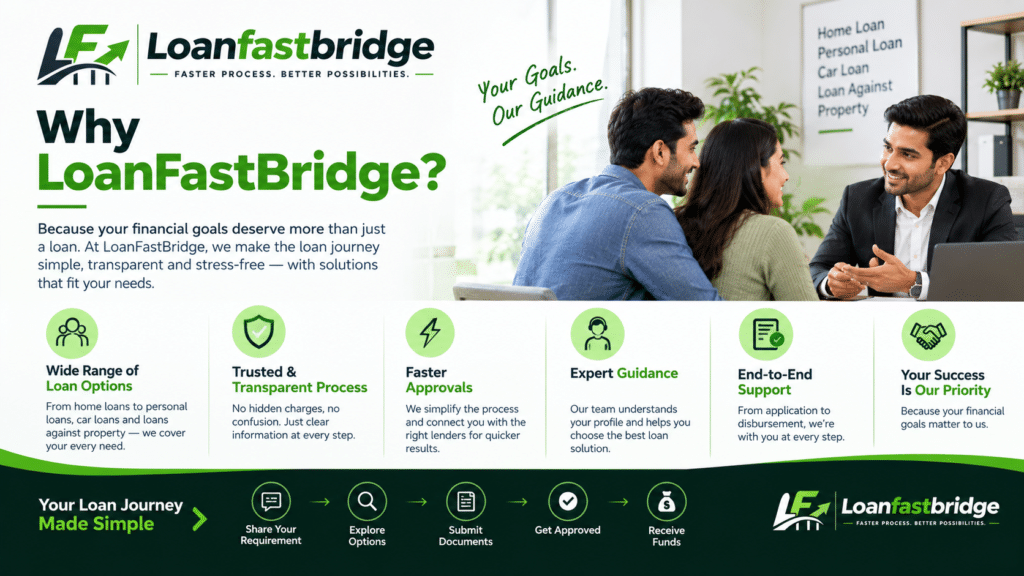
At LoanFastBridge, the focus is on simplifying the loan journey for customers.
Instead of treating every borrower the same, the approach begins with understanding the customer’s requirement and financial situation.
Whether you are exploring a home loan, personal loan, car loan, or loan against property, the objective is to help you understand the available possibilities and the factors that should be considered before proceeding.
The process can include:
Requirement Understanding → Eligibility Discussion → Loan Options → Documentation Guidance → Application Support → Process Follow-Up
The exact process and final loan terms depend on the selected lender and the customer’s eligibility.
LoanFastBridge aims to make the process easier to understand while helping customers make informed decisions.
Questions to Ask Before Taking a Loan
Before finalizing any loan, ask the following questions:
What is the applicable interest rate?
Understand whether the rate is fixed, floating, or structured according to the lender’s product terms.
What will be my EMI?
Make sure the monthly repayment fits comfortably within your budget.
What is the total repayment amount?
Looking only at EMI can hide the total cost of borrowing.
Are there processing or other charges?
Ask for clarity regarding applicable fees and charges.
What is the loan tenure?
Understand how the tenure affects both EMI and total interest.
Can I prepay the loan?
Ask about applicable prepayment or foreclosure conditions.
What happens if I miss an EMI?
Understand the applicable charges and consequences of delayed repayment.
What documents are required?
Preparing documents in advance can help avoid unnecessary delays.
Common Mistakes Borrowers Should Avoid
Borrowing More Than Necessary
Just because you are eligible for a certain amount does not mean you should borrow the entire amount.
Choosing Only on Interest Rate
Compare the complete cost and terms of the loan rather than focusing on one number.
Ignoring the Fine Print
Read the loan documents carefully before accepting the agreement.
Not Comparing Options
Different lenders may have different eligibility requirements and pricing structures. Comparing options can help you make a better-informed choice.
Focusing Only on EMI
A low EMI can sometimes mean a longer tenure and higher overall repayment.
Making Decisions Under Pressure
Take enough time to understand the loan before committing yourself to a long-term financial obligation.
Final Thoughts: Finding the Best Loan Consultancy
Finding the best loan consultancy is not simply about finding someone who can help you obtain a loan.
It is about finding professional guidance that helps you understand your options, compare relevant factors, prepare the required documentation, and navigate the loan process with greater confidence.
The right loan depends on your financial requirement, income, repayment ability, credit profile, loan purpose, and lender-specific conditions.
Whether you are planning to buy your dream home, purchase a car, manage an important personal expense, or explore funding against property, taking the time to understand your financing options can make a significant difference.
LoanFastBridge is focused on making the loan journey simpler and more understandable by providing assistance across different loan requirements, including home loans, personal loans, car loans, and loans against property.
Before making any financial decision, compare available options, understand the applicable costs and conditions, and make sure the repayment obligation fits comfortably within your financial plan.
A loan should not simply be easy to obtain. It should be suitable for your needs and manageable for your financial future.
If you are exploring your loan options, LoanFastBridge can help you begin the process with clearer information and structured guidance.