
Buying a car is a significant financial decision. Whether you are purchasing your first vehicle, upgrading to a new model, or choosing a used car, paying the entire cost upfront may not always be practical. Can help eligible borrowers finance the purchase while spreading the repayment over a defined period.
Car loans are commonly offered by banks, NBFCs, and other financial institutions. The loan amount, interest rate, repayment tenure, down payment, processing fees, and eligibility requirements can vary depending on the lender, vehicle, and borrower’s financial profile.
Understanding how car loans work before applying can help you compare options, estimate your monthly EMI, prepare the required documents, and avoid taking on an unaffordable financial commitment.
This guide explains the important aspects of car loans in India, including eligibility, interest rates, down payment, EMI, documentation, benefits, common mistakes, and the application process.
What Is a Car Loan?
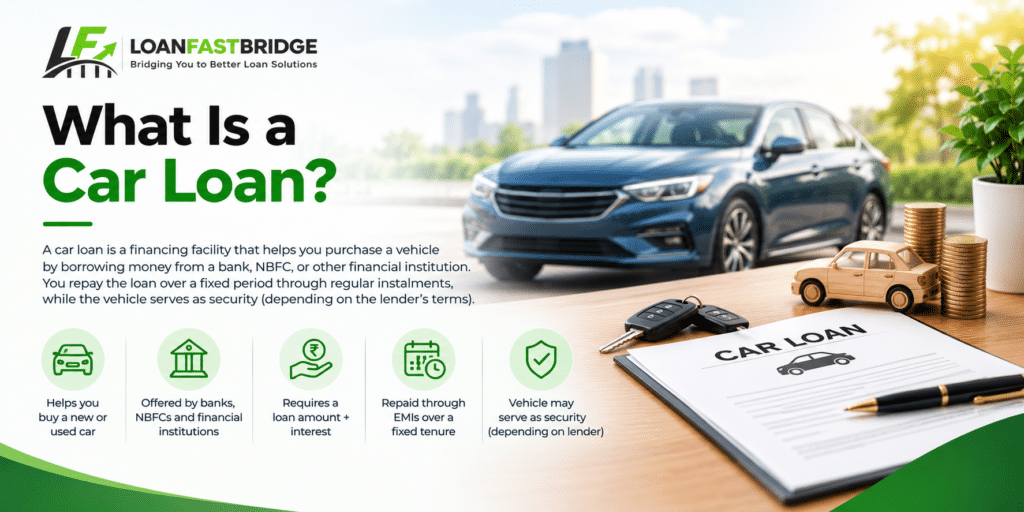
A car loan is a financing facility that allows an eligible borrower to purchase a vehicle by borrowing money from a lender and repaying it over an agreed period.
Depending on the lender and product, car loans may be available for:
- New cars
- Used cars
- Certain commercial or other eligible vehicles
The lender generally pays the approved financing amount according to the loan arrangement, while the borrower contributes the required down payment and repays the loan through scheduled instalments.
Unlike a personal loan, a car loan is generally linked specifically to the purchase of a vehicle. The vehicle may serve as security for the financing, subject to the lender’s terms and applicable documentation.
The exact structure can differ between lenders, so borrowers should carefully review the loan agreement before accepting an offer.
How Does Work?
The car loan process generally begins with selecting a vehicle and estimating how much financing you require.
For example, suppose the on-road price of a car is ₹10 lakh. If you make a ₹2 lakh down payment and finance the remaining ₹8 lakh, the lender may provide a loan of up to the eligible amount, subject to its assessment and policies.
You then repay the borrowed amount, along with applicable interest and charges, through EMIs over the selected tenure.
Your monthly EMI generally depends on:
- Loan amount
- Interest rate
- Repayment tenure
A longer tenure can reduce the monthly EMI, but it can also increase the total interest paid over the life of the loan. A shorter tenure generally results in a higher EMI but may reduce the overall interest cost.
Therefore, selecting a car loan should involve more than asking, “How much EMI can I afford?”
You should also consider the total cost of the loan.
Why Do People Choose?
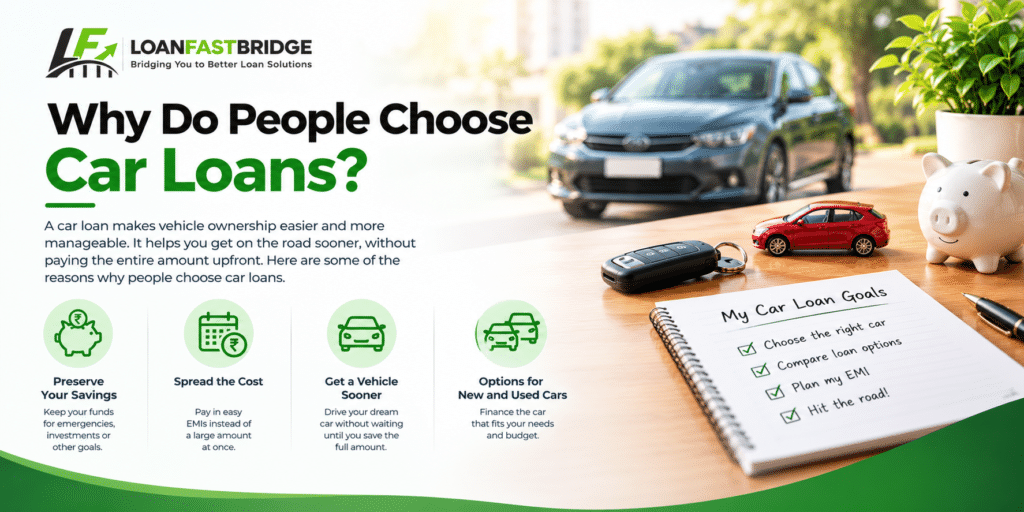
A car loan can make vehicle ownership more manageable for borrowers who have sufficient repayment capacity but prefer not to use all their savings at once.
Preserve Some Savings
Instead of paying the entire vehicle cost upfront, financing a portion may allow you to retain some savings for emergencies, investments, or other planned expenses.
However, borrowing should still be based on affordability rather than simply preserving cash.
Spread the Cost
A divides the repayment into scheduled instalments, making the purchase cost easier to manage within a monthly budget.
Purchase a Vehicle Sooner
For eligible borrowers, financing can make it possible to purchase a vehicle without waiting until the entire purchase price has been accumulated.
Options for New and Used Cars
Depending on the lender, financing may be available for both new and used vehicles. Used-car loans can have different eligibility requirements, interest rates, valuation methods, and repayment periods.
Types of Car Loans

Not every car loan works in exactly the same way. The financing options available to you can depend on the vehicle and lender.
New Car Loan
A new car is designed to finance the purchase of a new vehicle from an eligible dealer.
Lenders may consider the vehicle’s price, applicant’s financial profile, income, credit history, and other factors when determining the loan amount and terms.
Used Car Loan
Used-car financing allows eligible borrowers to finance a pre-owned vehicle.
Because used vehicles differ in age, condition, valuation, and resale value, lenders may apply different conditions compared with new-car financing.
The borrower should check:
- Vehicle age requirements
- Maximum loan-to-value criteria
- Applicable interest rate
- Maximum repayment tenure
- Vehicle valuation
- Documentation requirements
- Applicable fees
Before purchasing a used car, it is also important to independently verify the vehicle’s condition, ownership history, insurance, registration, and applicable legal documentation.
Who Can Apply for?
Eligibility varies from one lender to another. There is no universal income level or credit score that guarantees approval.
Lenders may consider factors such as:
- Age
- Income
- Employment or business stability
- Credit history
- Existing EMIs
- Existing debts
- Bank account activity
- Type and price of vehicle
- Loan amount requested
- Repayment capacity
- Relationship with the lender
Both salaried and self-employed individuals may be eligible, provided they satisfy the lender’s requirements.
Meeting basic eligibility criteria does not guarantee approval. The final decision is made by the lender after reviewing the application and completing its verification process.
Car Loan for Salaried Individuals
Salaried employees may be assessed based on their monthly income, employer profile, employment continuity, credit history, existing financial commitments, and banking information.
A stable income can demonstrate repayment capacity, but lenders may consider several other factors before approving the loan.
Before applying, salaried applicants should calculate their existing EMIs and regular household expenses. Adding a new car loan should not make the monthly budget unnecessarily tight.
Car Loan for Self-Employed Individuals
Self-employed professionals, business owners, and other eligible individuals may also apply for car financing.
Lenders may request additional financial information to understand income and repayment capacity. This can include bank statements, income-tax documents, business-related records, or other financial documentation.
Because business income may fluctuate, self-employed applicants should assess their repayment ability using realistic income figures rather than relying on their best-performing months.
Car Loan Interest Rates
The interest rate is one of the most important factors when comparing car loans.
The applicable rate can depend on factors such as:
- Credit profile
- Income
- Employment or business stability
- Loan amount
- Vehicle type
- New or used vehicle
- Loan tenure
- Lender’s policies
- Overall risk assessment
A lender may advertise a starting interest rate, but that does not necessarily mean every borrower will receive that rate.
Always compare the actual rate offered to you and understand whether the rate is fixed, floating, or structured in another way according to the loan agreement.
Do not choose a car loan based only on the lowest advertised rate.
What Is a Down Payment?
The down payment is the portion of the vehicle’s purchase cost that you pay from your own funds rather than borrowing through the loan.
For example, if the applicable vehicle cost is ₹10 lakh and you contribute ₹2 lakh while financing ₹8 lakh, the ₹2 lakh represents your contribution toward the purchase.
A larger down payment generally means a smaller loan amount.
A smaller loan can result in:
- Lower EMI
- Lower total interest, assuming other terms remain unchanged
- Reduced overall borrowing
However, using all your savings for a large down payment may leave you with insufficient emergency funds.
The right down payment depends on your financial position, available savings, expected expenses, and lender requirements.
How Is EMI Calculated?
EMI stands for Equated Monthly Instalment.
It is the scheduled amount you generally pay every month toward the loan.
The EMI is primarily determined by:
Principal + Interest + Repayment Tenure
For a standard amortising loan, each EMI generally contains both a principal component and an interest component.
For example, if you borrow ₹8 lakh, the EMI will depend on the interest rate and tenure selected.
The same ₹8 lakh loan can have very different EMIs if the repayment period changes.
This is why borrowers should compare multiple scenarios before selecting a tenure.
Longer Tenure vs Shorter Tenure
A longer tenure can make the monthly EMI more manageable.
However, because the loan remains outstanding for a longer period, the total interest paid can be higher.
A shorter tenure usually means a higher monthly EMI but potentially lower total interest.
The best tenure is therefore not automatically the shortest or longest one. It should be a period that allows you to repay comfortably without unnecessarily increasing the total cost.
What Documents Are Required?
Documentation requirements vary by lender and applicant.
Commonly requested documents may include:
- Identity proof
- Address proof
- PAN or applicable financial identification
- Recent photographs, where required
- Salary slips for salaried applicants
- Bank statements
- Income-tax documents
- Employment information
- Business documents for self-employed applicants
- Vehicle quotation or invoice
- Other documents requested by the lender
The lender may request additional documentation depending on your profile.
Providing accurate information is essential. Do not alter income information or submit inaccurate documents simply to improve the chances of approval.
Credit Score and Approval
Your credit history can influence how a lender evaluates your car loan application.
A credit report can provide information about your previous borrowing and repayment behaviour. Regularly paying existing loans and credit-card obligations on time can support a healthier credit profile.
On the other hand, missed or delayed payments can negatively affect your credit history.
Before applying for a car loan, consider reviewing your credit report and checking whether the information is accurate.
Remember that your credit score is only one part of the assessment. Lenders may also consider income, existing liabilities, employment, banking history, loan amount, and other factors.
What Is Loan-to-Value Ratio?
Loan-to-value, often referred to as LTV, broadly represents the relationship between the amount financed and the value or eligible cost of the vehicle.
For example, if a vehicle is valued at ₹10 lakh and a lender finances ₹8 lakh, the financing represents 80% of the vehicle value.
The exact amount a lender is willing to finance depends on its policies and the borrower’s profile.
Understanding the financing percentage can help you estimate how much money you may need to contribute upfront.
Additional Costs to Consider
The interest rate is not the only expense associated with a car loan.
Depending on the lender and loan product, additional charges may include:
- Processing fees
- Documentation charges
- Applicable taxes
- Prepayment or foreclosure charges, where applicable
- Late-payment charges
- Other lender-specific fees
Always ask for a complete breakdown of applicable charges before accepting the loan.
A loan with a slightly lower interest rate may not necessarily be the cheapest if it carries significantly higher fees.
New Car Loan vs Used Car Loan
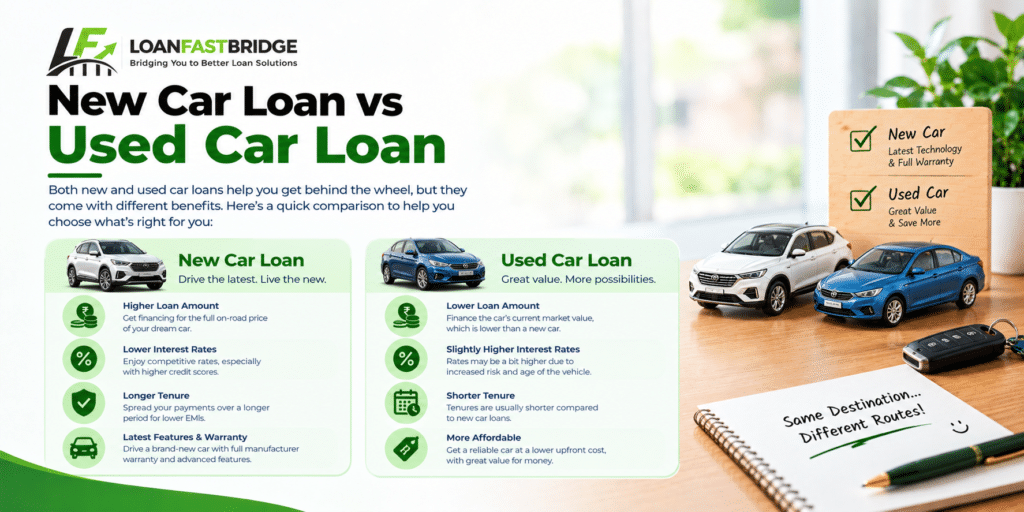
Choosing between a new and used vehicle involves more than comparing purchase prices.
| Factor | New Car | Used Car |
|---|---|---|
| Purchase price | Generally higher | Generally lower |
| Vehicle condition | New | Depends on history and maintenance |
| Financing | Often widely available | Availability varies |
| Interest rate | May be more competitive | Can be higher depending on lender |
| Depreciation | Usually higher initially | Previous depreciation already occurred |
| Loan tenure | May be longer | Often depends on vehicle age |
| Inspection | Usually straightforward | Vehicle inspection may be important |
If you are considering a used car, do not evaluate only the EMI. Consider maintenance costs, insurance, vehicle age, resale value, and financing costs.
Benefits of Taking
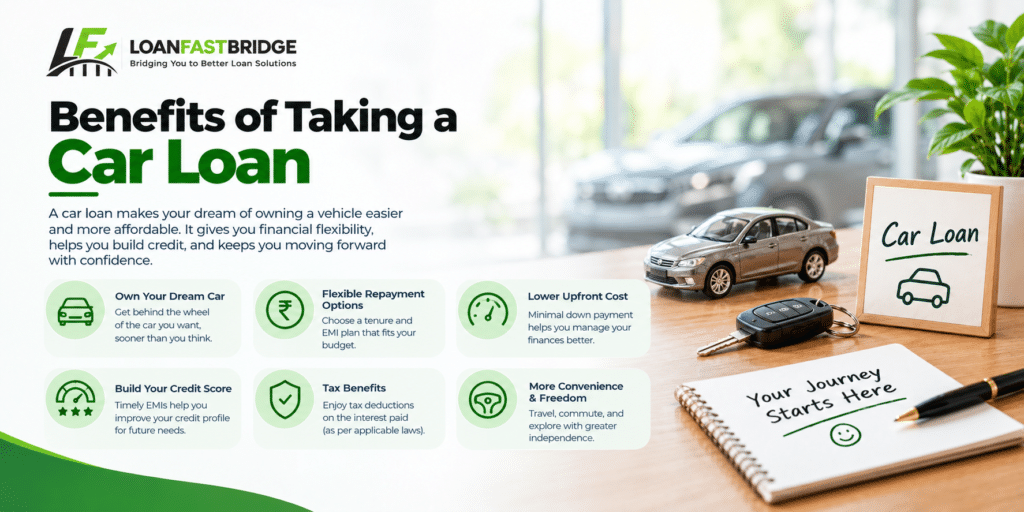
A car loan can provide several potential benefits when used responsibly.
Manageable Monthly Payments
Instead of paying the entire purchase price immediately, you can spread the repayment over an agreed period.
Potentially Higher Liquidity
Financing part of the purchase can allow you to retain some savings for emergencies or other financial priorities.
Structured Repayment
A defined repayment schedule can make monthly budgeting easier.
Choice of Vehicle
Financing may allow eligible borrowers to consider vehicles that would otherwise require a longer period of saving.
However, the availability of financing does not mean you should purchase a more expensive vehicle than your budget allows.
Mistakes to Avoid When Taking a Loan
Choosing a Car Based Only on EMI
A low EMI may result from a longer tenure. Always check the total repayment amount.
Ignoring the Down Payment
A smaller down payment may mean a larger loan and potentially greater interest costs.
Forgetting Ownership Costs
Your car budget should include more than the EMI.
Consider:
- Fuel
- Insurance
- Maintenance
- Parking
- Repairs
- Registration-related costs
- Other regular expenses
Taking the Maximum Loan Available
Just because a lender is willing to finance a certain amount does not mean you should borrow the maximum.
Choose a loan based on your actual requirement and repayment capacity.
Ignoring the Fine Print
Read the sanction letter and loan agreement carefully. Understand interest, fees, repayment schedule, prepayment terms, and consequences of delayed payments.
Making Multiple Unnecessary Applications
Applying for loans repeatedly without understanding eligibility can create unnecessary credit enquiries and complicate your borrowing process.
How to Choose the Right
When comparing car loans, use a complete evaluation rather than focusing on a single number.
Compare Interest Rates
Check the actual rate applicable to your profile rather than relying only on advertised starting rates.
Compare Total Repayment
Calculate how much you will repay over the complete tenure.
Review Processing Fees
Understand all applicable charges before proceeding.
Select a Practical Tenure
Choose a tenure that balances EMI affordability with total borrowing cost.
Check Prepayment Terms
If you expect to close the loan early, understand the applicable rules and charges.
Consider the Down Payment
A suitable down payment can reduce the amount you need to borrow, but do not exhaust your emergency savings unnecessarily.
Application Process
The application process generally follows these stages:
Step 1: Decide Your Vehicle Budget
Determine the maximum vehicle cost that fits comfortably within your finances.
Step 2: Calculate Your Down Payment
Decide how much you can contribute without compromising your financial safety.
Step 3: Estimate Your Loan Requirement
Calculate the amount you actually need to borrow.
Step 4: Compare Lenders
Review interest rates, tenure, fees, eligibility, and other applicable terms.
Step 5: Check Eligibility
Review your income, credit profile, existing obligations, and documentation.
Step 6: Submit the Application
Provide the lender with the required information and documents.
Step 7: Verification
The lender may verify your identity, income, employment, banking information, and other relevant details.
Step 8: Loan Approval
If the application meets the lender’s requirements, the lender may issue a sanction or approval with applicable terms.
Step 9: Documentation and Disbursement
After completing the required documentation and other formalities, the approved financing may be disbursed according to the lender’s process.
How Loan Consultancy Can Help
Understanding multiple lenders and loan products can take time, especially when eligibility requirements, interest rates, documentation, and charges differ.
A professional loan consultancy can help simplify the process by assisting borrowers with:
- Understanding car loan requirements
- Reviewing basic eligibility
- Comparing potentially suitable financing options
- Understanding documentation
- Organising application information
- Explaining loan-related terminology
- Navigating the application process
A consultant does not replace the lender’s assessment. The final approval, interest rate, loan amount, and conditions are determined by the lender.
Borrowers should also verify the final loan terms directly through the lender’s official documentation before accepting an offer.
Why Choose Loanfastbridge for Car Loan Assistance?
Loanfastbridge aims to simplify the loan journey for individuals looking for suitable financing solutions.
If you are planning to purchase a new or used car, getting clarity before applying can help you make a more informed decision.
Loanfastbridge can assist customers in understanding their basic requirements, exploring suitable loan options, preparing documentation, and navigating the application process.
The focus should not simply be on getting the largest possible loan. A suitable car loan should align with your income, existing financial obligations, vehicle cost, down payment, and repayment capacity.
Whether you are purchasing your first car or upgrading your existing vehicle, evaluating the complete financial commitment can help you avoid unnecessary pressure later.
Frequently Asked Questions
What is a car loan?
A car loan is financing provided by a bank, NBFC, or other financial institution to help an eligible borrower purchase a vehicle and repay the borrowed amount with applicable interest over an agreed period.
Is a down payment required?
The required upfront contribution depends on the lender, vehicle, loan structure, and borrower profile. A larger down payment generally reduces the amount that needs to be financed.
Can I get a used vehicle?
Yes, some lenders provide financing for eligible used vehicles. Requirements can differ based on vehicle age, valuation, condition, borrower profile, and lender policy.
Does my credit score affect approval?
Credit history can influence the lender’s assessment. However, approval is generally based on multiple factors, including income, existing obligations, employment or business profile, and repayment capacity.
Can self-employed people apply?
Yes. Self-employed applicants may be eligible, subject to the lender’s requirements and verification of income and financial documents.
Is a longer loan tenure better?
Not necessarily. A longer tenure may lower the monthly EMI but can increase the total interest paid. Compare both monthly affordability and overall repayment cost.
Can I repay my loan early?
Early repayment may be possible depending on the loan agreement and lender’s policies. Check applicable prepayment or foreclosure conditions and charges before making an early repayment.
What happens if I miss a car loan EMI?
A missed EMI may result in applicable charges and can negatively affect your credit history. If you anticipate difficulty making a payment, communicate with the lender as soon as possible.
Should I choose the lender offering the lowest interest rate?
Not necessarily. Compare the complete cost, including interest, processing fees, other applicable charges, tenure, repayment terms, and prepayment conditions.
Final Thoughts
A car loan can make vehicle ownership more accessible by allowing eligible borrowers to spread the cost of a purchase over a structured repayment period. However, financing a vehicle is a long-term financial commitment, and the decision should be based on affordability rather than simply the amount a lender is willing to provide.
Before applying, determine your vehicle budget, calculate your down payment, estimate the EMI, compare lenders, review the total repayment cost, and understand all applicable charges.
Remember that the actual cost of owning a car extends beyond the loan. Fuel, insurance, maintenance, parking, repairs, and other running expenses should also be included in your financial planning.
If you are exploring a car loan, Loanfastbridge can help make the process easier to understand by providing guidance on available financing options, basic eligibility, documentation, and the application journey.
The right car loan is not necessarily the one with the largest approved amount or the lowest advertised EMI. It is the financing option whose terms fit your financial circumstances and whose repayment you can manage comfortably throughout the loan period.