
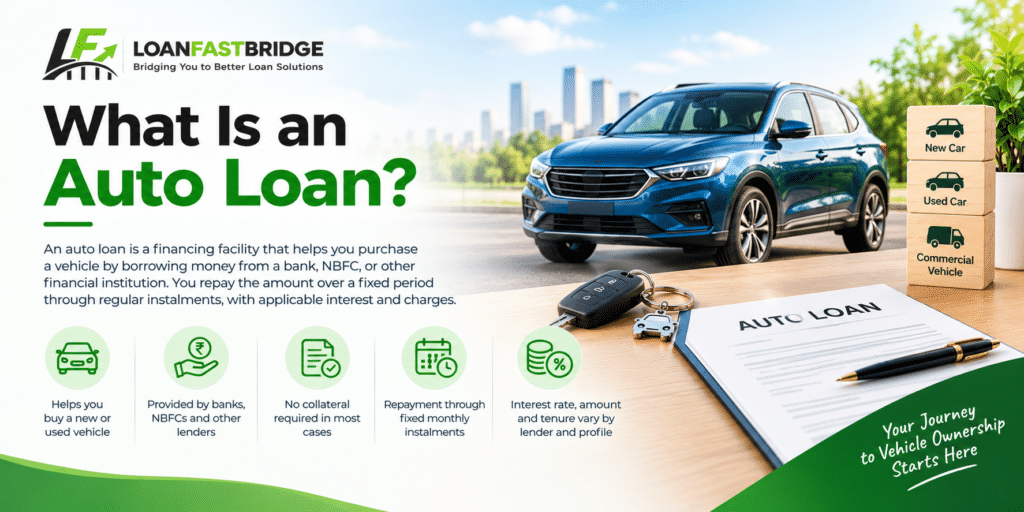
Buying a vehicle is a major financial decision. Whether you are purchasing your first car, replacing an older vehicle, or choosing a pre-owned model, paying the complete price upfront may not always be practical. Auto loan allows eligible buyers to spread the cost over a defined repayment period instead of using a large portion of their savings at once.
An auto loan is one of the financing options available to individuals who want to purchase an eligible vehicle. Banks, NBFCs, and other financial institutions may offer different products depending on the type of vehicle, borrower profile, loan amount, repayment period, and other factors.
Although financing can make vehicle ownership more accessible, it also creates a long-term financial obligation. The right decision therefore requires more than comparing monthly instalments. Borrowers should understand the interest rate, total repayment amount, fees, down payment, eligibility requirements, and running costs of the vehicle before proceeding.
This guide explains the major aspects of vehicle financing in India and provides practical information to help you approach the process with greater clarity.
What Is an Auto Loan?
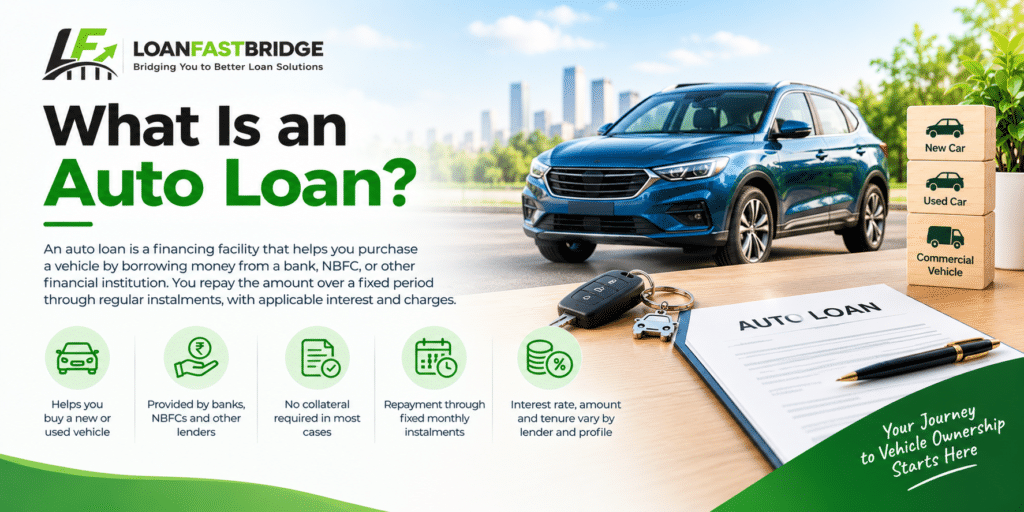
An auto loan is a financing facility that allows an eligible borrower to borrow money for purchasing a vehicle and repay the amount over an agreed period.
Depending on the lender and product, financing may be available for:
- New cars
- Used cars
- Certain commercial vehicles
- Other eligible automobiles
The borrower usually contributes an upfront amount toward the purchase and finances the remaining eligible amount through the lender.
In many vehicle-financing arrangements, the vehicle is used as security for the facility, subject to the lender’s terms and applicable documentation. The borrower then makes regular repayments until the outstanding amount has been cleared.
The exact amount a lender is willing to finance, the applicable interest rate, repayment period, fees, and other conditions depend on the lender and the applicant’s financial profile.
How Does Auto loan Work?
The Auto loan process generally begins with deciding which vehicle you want to purchase and estimating its total cost.
Suppose the on-road price of a vehicle is ₹12 lakh. If you contribute ₹3 lakh from your own funds and finance ₹9 lakh, the borrowed amount would be ₹9 lakh, subject to the lender’s eligibility and financing limits.
The lender evaluates your application before deciding whether to approve the requested amount. This assessment can include your income, employment or business profile, credit history, existing financial obligations, banking information, and other relevant details.
Once approved, the borrower repays the amount through scheduled instalments.
The monthly payment generally consists of:
- Principal repayment
- Interest
- Applicable charges, where included according to the repayment structure
The repayment period can range from a relatively short duration to several years, depending on the lender, vehicle, applicant, and product.
A longer repayment period can reduce the monthly instalment but may increase the total interest paid. A shorter period can increase the monthly commitment while potentially reducing the overall interest cost.
Why Do People Choose Auto loan?
There are several reasons an eligible buyer may consider financing rather than paying the entire vehicle cost upfront.
Preserving Savings
Using financing can allow you to retain some savings for emergencies, investments, household requirements, or other financial goals.
However, keeping savings while taking on unnecessary debt may not always be financially beneficial. The decision should be based on the overall cost and your financial circumstances.
Spreading the Purchase Cost
Instead of making one large payment, financing allows the cost to be divided into regular instalments.
This can make budgeting easier when the monthly commitment fits comfortably within your income.
Purchasing a Vehicle Earlier
A buyer may be able to purchase a vehicle sooner rather than waiting until the full purchase price has been saved.
This can be particularly relevant when a vehicle is required for commuting, family responsibilities, professional activities, or other practical needs.
Access to Different Vehicle Categories
Depending on eligibility and affordability, financing may make it possible to consider a wider range of vehicles. However, approval for a larger amount does not mean that borrowing the maximum amount is financially advisable.
Your vehicle budget should account for both the purchase price and ongoing ownership expenses.
Types of Auto Loans
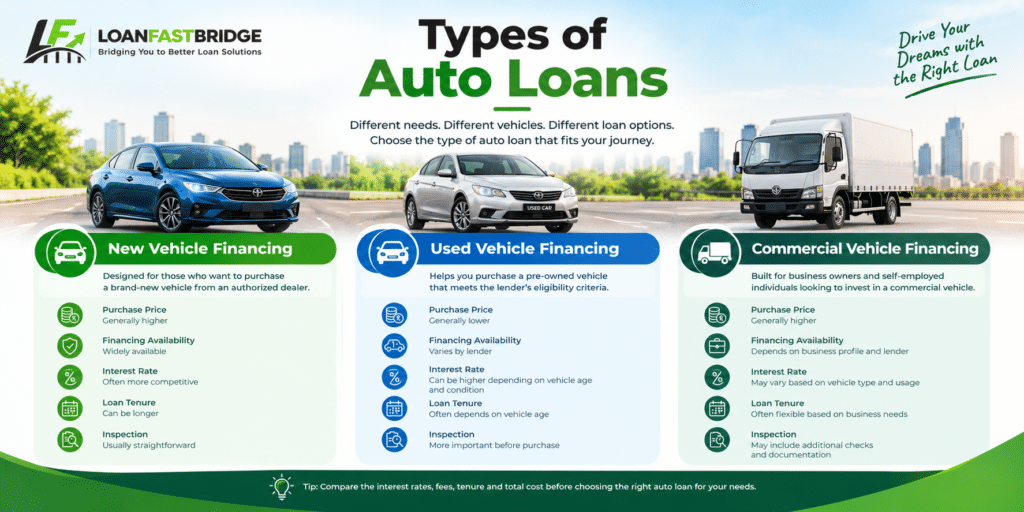
Vehicle financing is not limited to one type of product. The available options can differ according to the vehicle and lender.
New Auto loan
New Auto loan is designed for the purchase of a new automobile from an eligible dealer.
The lender may consider the vehicle’s price, model, applicant’s income, credit profile, employment or business stability, requested amount, and other factors.
New vehicles may have broader financing availability, although the exact terms vary between lenders.
Used Auto loan
Used Auto loan can help eligible buyers purchase a pre-owned automobile.
Because a used vehicle’s value depends on factors such as age, condition, mileage, ownership history, and market value, lenders may apply different requirements compared with new vehicles.
Before financing a pre-owned vehicle, buyers should check:
- Vehicle age
- Service history
- Insurance records
- Registration details
- Ownership history
- Outstanding liabilities
- Mechanical condition
- Market value
- Applicable lender requirements
The financing cost can also differ from that of a new vehicle.
Commercial Auto loan
Some financial institutions provide financing for eligible commercial vehicles. The assessment may involve additional considerations, including the applicant’s business activity, income, vehicle usage, and documentation.
Requirements vary significantly, so applicants should confirm the applicable conditions with the lender.
Who Can Apply for a Auto loan?
Eligibility depends on the lender and the particular financing product Auto loan.
Applicants may be evaluated based on:
- Age
- Income
- Employment or business stability
- Credit history
- Existing loans
- Monthly financial commitments
- Banking history
- Vehicle type
- Requested financing amount
- Repayment capacity
Both salaried employees and self-employed individuals may be eligible for Auto loan.
However, there is no universal eligibility standard that guarantees approval. A lender may approve, reject, or modify an application based on its internal assessment.
Meeting basic eligibility criteria therefore does not automatically mean that financing will be approved.
Financing for Salaried Employees
Salaried applicants may be assessed using information such as monthly income, employer profile, length of employment, existing liabilities, credit history, and bank statements.
A stable source of income can help demonstrate repayment capacity, but it is only one part of the assessment.
Before applying, calculate your existing monthly commitments.
For example, if you already have rent, education expenses, credit-card payments, and other EMIs, adding another instalment may reduce your available monthly cash flow.
A vehicle should fit comfortably within your overall household budget rather than being selected solely according to the maximum amount a lender is willing to finance.
Financing for Self-Employed Individuals
Business owners, professionals, and other self-employed applicants may also seek Auto loan.
Because self-employed income can fluctuate, lenders may request additional information to evaluate financial stability.
Documents can include:
- Bank statements
- Income-tax records
- Business registration documents
- Financial statements
- Proof of business continuity
- Other relevant financial records
Applicants should use realistic income figures when planning repayments. A strong business month should not be treated as a guarantee of future income.
Credit Score and Auto loan
Credit history can influence the way a lender evaluates your application.
A credit report provides information about previous borrowing and repayment behaviour. Consistent repayment of existing credit obligations can demonstrate responsible financial management.
Missed or delayed payments may negatively affect your credit profile.
Before applying, consider reviewing your credit report for errors or outdated information. If you identify an issue, resolving it may be worthwhile before submitting a new application.
A credit score does not determine approval by itself. Lenders may also evaluate income, employment, existing debt, banking activity, requested amount, and other factors.
Understanding Interest Rates in Auto loan
The interest rate represents the cost charged for borrowing money.
Rates can differ between lenders and applicants. Factors that may influence the rate include:
- Credit history
- Income
- Employment stability
- Existing liabilities
- Loan amount
- Repayment tenure
- Vehicle type
- Lender policies
- Overall risk assessment
A lender may advertise a starting rate, but the rate available to an individual applicant may be different.
Always review the actual rate included in the offer rather than relying solely on promotional figures.
It is also useful to determine whether the rate is fixed, floating, or structured according to another arrangement described in the loan agreement.
What Is a Down Payment?
A down payment is the portion of the vehicle cost that the buyer contributes directly.
For example, if the eligible purchase cost is ₹10 lakh and the buyer contributes ₹2.5 lakh, the remaining amount may potentially be financed, subject to lender criteria.
A higher contribution generally reduces the amount borrowed.
This can potentially result in:
- Lower monthly instalments
- Lower overall interest
- Reduced total debt
However, using too much of your savings for the upfront contribution can leave you without an adequate emergency reserve.
A sensible approach is to balance the upfront contribution with your broader financial needs.
How Is EMI Calculated in Auto loan?
EMI stands for Equated Monthly Instalment.
It is the scheduled amount paid periodically toward the financing.
The amount is primarily influenced by:
Principal + Interest Rate + Tenure
Consider a hypothetical example. If two borrowers each finance ₹8 lakh at the same interest rate but choose different repayment periods, their monthly instalments will differ.
The borrower selecting a longer tenure may have a lower monthly payment but may pay more interest over the complete period.
The borrower selecting a shorter tenure may have a higher monthly obligation but could pay less interest overall.
Therefore, borrowers should not choose a tenure solely because it produces the smallest EMI.
The appropriate repayment period should fit your income while keeping the overall cost reasonable.
Total Cost of Vehicle Ownership
One of the most common mistakes buyers make is focusing only on the financing payment.
Owning a vehicle involves several additional expenses.
Your budget may need to account for:
- Fuel
- Insurance
- Maintenance
- Repairs
- Parking
- Registration-related expenses
- Tyres
- Servicing
- Accessories
- Road-related costs
A vehicle that appears affordable based on its monthly instalment may become expensive when all running costs are considered.
Before purchasing, estimate the complete monthly ownership cost.
Documents Required
Documentation varies depending on the lender, applicant, and vehicle.
Common documents may include:
- Identity proof
- Address proof
- PAN or applicable identification
- Recent photographs, where required
- Salary slips
- Bank statements
- Employment information
- Income-tax documents
- Business documents for self-employed applicants
- Vehicle quotation or invoice
- Other documents requested by the lender
Used-vehicle financing may require additional documents related to the automobile, including registration and ownership information.
Always provide accurate and complete information. Submitting incorrect or misleading documentation can result in rejection and may create additional complications.
New vs Used Auto loan
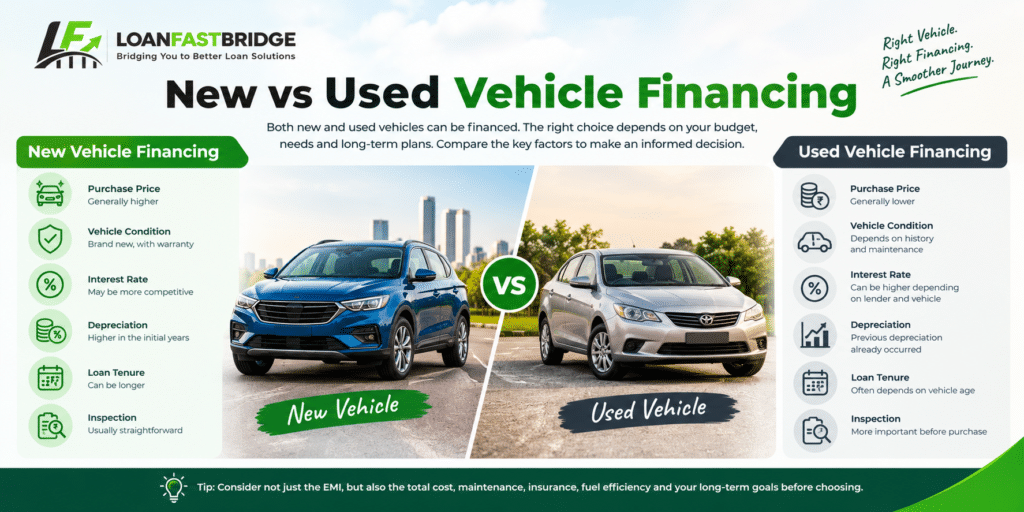
Choosing between a new and pre-owned automobile involves more than comparing the purchase prices.
| Factor | New Vehicle | Used Vehicle |
|---|---|---|
| Purchase price | Usually higher | Generally lower |
| Condition | New | Depends on history and maintenance |
| Financing availability | Often broad | Varies by lender |
| Interest cost | May be more competitive | Can differ by vehicle and lender |
| Depreciation | Higher during early years | Previous depreciation has already occurred |
| Loan period | Can be longer | Often influenced by vehicle age |
| Inspection | Generally simpler | More important before purchase |
A used automobile can have a lower purchase price but potentially higher maintenance requirements.
A new vehicle may cost more initially but could provide greater predictability regarding condition and warranty coverage.
The appropriate choice depends on your budget, intended usage, expected ownership period, and financial priorities.
Additional Charges to Check
The interest rate is not the only cost associated with financing.
Depending on the lender and product, charges may include:
Processing Fees in Auto loan
Some lenders charge a fee for evaluating and processing an application.
Documentation Charges in Auto loan
Certain administrative or documentation costs may apply.
Taxes in Auto loan
Applicable taxes may be charged on specific services or fees.
Late-Payment Charges in Auto loan
Failure to make repayments according to the agreed schedule may result in additional charges.
Prepayment or Foreclosure Charges Auto loan
If you intend to close the financing early, check the applicable rules and charges before doing so.
Always request a clear explanation of the total applicable costs before accepting the offer.
Benefits of an Auto Loan
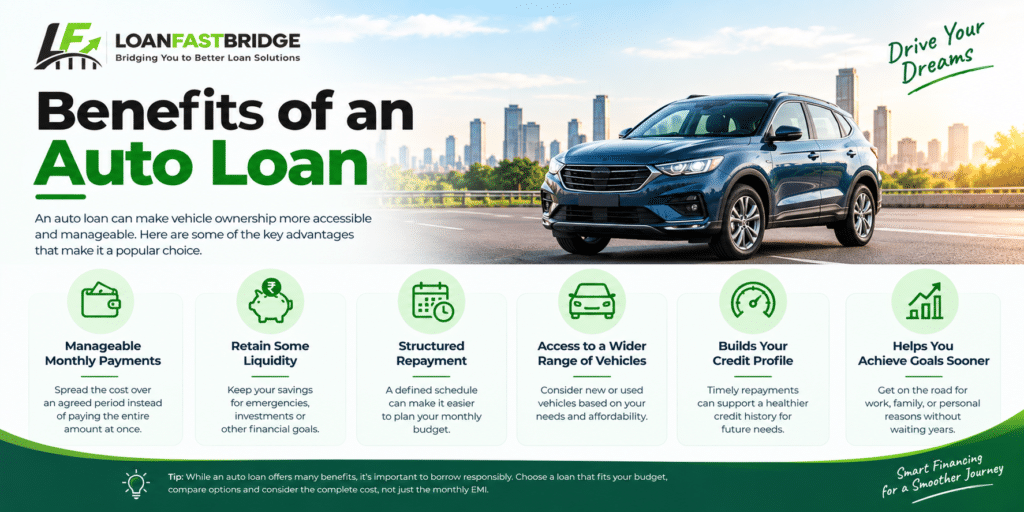
When used responsibly, vehicle financing can provide several practical advantages.
Manageable Repayment
The purchase price can be divided into scheduled payments rather than requiring the full amount immediately.
Retain Some Liquidity
Financing part of the purchase can allow you to retain savings for emergencies or other financial requirements.
Predictable Budgeting
A defined repayment schedule can make monthly financial planning easier.
Options for Different Vehicles
Eligible borrowers may be able to finance both new and used automobiles depending on the lender.
However, the availability of financing should not encourage a buyer to purchase a vehicle beyond their means.
Common Mistakes to Avoid
Choosing Only on EMI
A low monthly payment may result from a longer tenure and a higher total interest cost.
Always check the complete repayment amount.
Borrowing the Maximum Available Amount
A lender’s maximum approval limit is not the same as your ideal borrowing amount.
Borrow according to your requirement and repayment capacity.
Ignoring Running Costs
Fuel, insurance, servicing, repairs, and parking can significantly increase the monthly cost of vehicle ownership.
Using All Your Savings
A very large upfront contribution can reduce the amount borrowed, but exhausting your savings may leave you financially vulnerable during emergencies.
Ignoring Credit History
Your existing repayment behaviour can influence future borrowing opportunities.
Overlooking Fees
Processing and other applicable charges can increase the total cost.
Failing to Read the Agreement
Review the final terms before signing. Understand the interest rate, payment schedule, fees, prepayment rules, and consequences of delayed repayment.
How to Choose the Right Financing Option
Before selecting a lender, compare several important factors.
1. Actual Interest Rate
Look at the rate offered to you rather than an advertised starting rate.
2. Total Repayment
Determine how much you will pay over the entire repayment period.
3. Upfront Contribution
Consider how much you can comfortably contribute without compromising your emergency savings.
4. Repayment Period
Choose a period that balances monthly affordability and overall cost.
5. Processing Charges
Ask for a complete breakdown of applicable fees.
6. Prepayment Conditions
If you may repay early, understand the relevant rules.
7. Lender Terms
Read the sanction letter and agreement carefully before accepting the facility.
Auto Loan Application Process
The process can generally be divided into several stages.
Step 1: Set Your Vehicle Budget
Determine how much you can reasonably spend based on income, savings, and existing financial obligations.
Step 2: Choose the Vehicle
Compare models based on price, fuel efficiency, maintenance, safety features, usage, and long-term ownership costs.
Step 3: Decide Your Upfront Contribution
Determine how much you can pay without significantly reducing your emergency reserve.
Step 4: Estimate the Required Financing
Calculate the remaining amount you may need to finance.
Step 5: Compare Lenders
Review rates, tenure, fees, eligibility requirements, and repayment conditions.
Step 6: Prepare Documentation
Collect the required identity, income, banking, employment, and vehicle-related documents.
Step 7: Submit the Application
Provide accurate information to the selected lender.
Step 8: Verification
The lender may verify income, identity, employment, banking information, credit history, and vehicle details.
Step 9: Approval and Documentation
If the application meets the lender’s requirements, the lender may issue an approval or sanction containing the applicable terms.
Step 10: Disbursement
After completing the required formalities, financing may be disbursed according to the lender’s process.
How Loan Consultancy Can Help
Understanding multiple lenders, eligibility requirements, interest rates, documents, and repayment structures can be time-consuming.
A professional loan consultancy can help simplify the process by assisting borrowers with:
- Understanding financing requirements
- Reviewing preliminary eligibility
- Identifying potentially suitable lenders
- Comparing relevant loan terms
- Understanding documentation
- Organising application information
- Navigating the application process
A consultant cannot guarantee approval, a particular rate, or a specific amount.
The final decision is made by the lender after completing its assessment and verification.
Borrowers should also review the official lender documentation before accepting any financing arrangement.
Why Choose Loanfastbridge for Auto Loan Assistance?
Loanfastbridge aims to make the Auto loan journey easier to understand for customers exploring suitable borrowing options.
Buying a vehicle involves more than finding a model you like. The financing arrangement should also fit your income, existing commitments, savings, and long-term plans.
Loanfastbridge can assist customers in understanding basic eligibility, documentation, financing options, and the application journey.
Whether you are considering a new vehicle or a pre-owned automobile, having a clearer understanding of the financing process can help you approach the decision more confidently.
The focus should be on finding a suitable arrangement rather than simply obtaining the largest possible amount.
Frequently Asked Questions
What is an auto loan?
It is a financing facility that allows an eligible borrower to purchase an automobile by borrowing money from a financial institution and repaying the amount over an agreed period with applicable interest.
Can I finance a used car?
Yes, some lenders offer financing for eligible pre-owned vehicles. Conditions can differ based on the vehicle’s age, value, condition, and the applicant’s financial profile.
Is a down payment necessary in Auto loan?
The required upfront contribution depends on the lender, vehicle, and financing structure. A higher contribution can reduce the amount borrowed.
Does credit score matter?
Yes. Credit history can influence the lender’s assessment, although approval also depends on income, existing obligations, employment or business profile, and other factors.
Can self-employed individuals apply?
Yes. Self-employed applicants may be eligible if they satisfy the lender’s requirements and provide the necessary financial information.
Is a longer tenure better?
Not necessarily. A longer period can lower the monthly payment but may increase total interest. Compare both monthly affordability and total repayment.
Can I repay the financing early?
Early repayment may be possible according to the lender’s terms. Check applicable prepayment or foreclosure conditions before making an early repayment.
What happens if I miss an instalment?
A missed payment may result in applicable charges and could negatively affect your credit history. Contacting the lender promptly if repayment difficulties arise is generally preferable to ignoring the issue.
Should I select the lowest advertised rate?
Not automatically. Compare the actual rate, processing fee, total repayment, tenure, and other applicable terms.
Final Thoughts
An auto loan can make vehicle ownership more accessible by allowing eligible buyers to divide a significant purchase into manageable repayments. However, the convenience of financing should be balanced with careful financial planning.
Before applying, determine your vehicle budget, calculate the upfront contribution, estimate the monthly payment, and review your existing financial commitments. Compare lenders based on the complete cost rather than focusing only on the advertised rate or EMI.
Remember that the cost of owning a vehicle extends beyond financing. Fuel, insurance, maintenance, repairs, parking, and other running expenses should be included in your budget.
Read the final loan agreement carefully and understand the applicable interest rate, fees, repayment schedule, prepayment conditions, and consequences of delayed payments.
If you are exploring vehicle financing, Loanfastbridge can help simplify the journey by providing guidance around eligibility, documentation, financing options, and the application process.
The most suitable financing arrangement is not necessarily the one offering the largest amount or the smallest monthly payment. It is the option whose overall cost and repayment requirements fit comfortably within your financial situation and long-term plans.