
Running a business requires careful financial planning. Whether you are launching a new venture, expanding an existing company, purchasing equipment, hiring employees, or managing day-to-day expenses, access to sufficient capital can make a significant difference to your business operations.
However, many entrepreneurs and small business owners do not always have enough funds available to meet every requirement from their personal savings or existing business income. In such situations, external financing can help them manage expenses, maintain cash flow, and pursue growth opportunities.
A business loan is one financing option that allows eligible enterprises to borrow money from banks, non-banking financial companies (NBFCs), and other authorised lenders. The borrowed funds can be used for permitted business purposes, subject to the lender’s conditions and the terms of the agreement.
Before applying, business owners should understand the different financing options, eligibility requirements, interest rates, documentation, repayment conditions, and potential risks.
This guide explains how business financing works in India and how entrepreneurs can evaluate their options before making a borrowing decision.
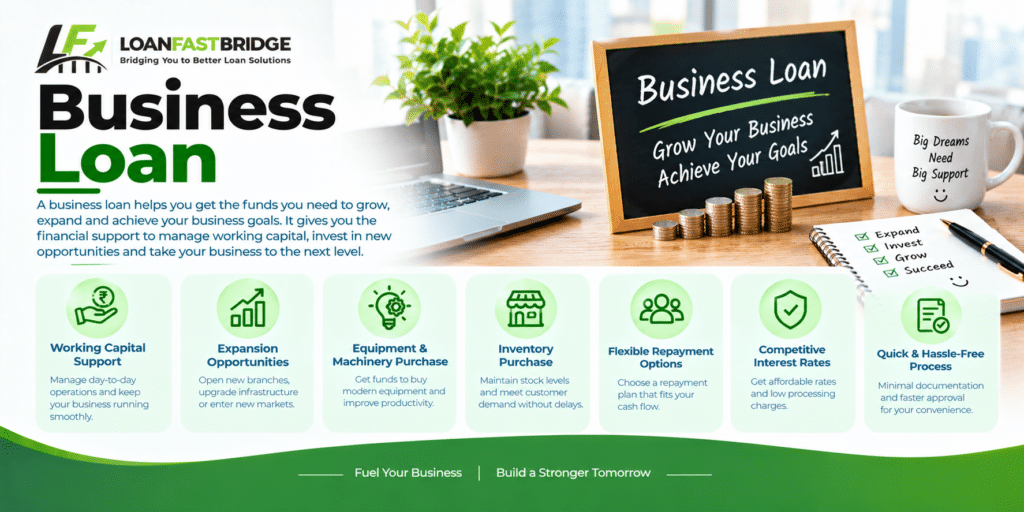
What Is a Business Loan?
A business loan is a financial facility provided to eligible enterprises or business owners to support commercial activities. Depending on the product, the borrowed funds may be used for working capital, inventory purchases, equipment, expansion, renovations, or other approved business expenses.
These facilities are offered by banks, NBFCs, and other eligible financial institutions. The amount approved, interest rate, repayment tenure, collateral requirements, and eligibility criteria vary according to the lender and the borrower’s financial profile.
For example, suppose a small retail shop needs ₹8 lakh to purchase additional inventory before a busy sales season. If the owner qualifies for suitable financing, the borrowed funds could help stock products and manage business operations while sales revenue is generated.
However, borrowing should always be based on a realistic financial plan. The business must have a reasonable way to meet repayment obligations even if sales are lower than expected.
Financing can support growth, but it does not guarantee profitability. Business owners should carefully assess their financial needs and repayment capacity before accepting an offer.
Why Do Businesses Need Financing?
Businesses require capital at different stages of their development. A new enterprise may need money to establish operations, while an established company may require additional funds to expand into new markets.
Common reasons for seeking financing include:
- Purchasing raw materials and inventory.
- Managing salaries, rent, and utility expenses.
- Buying machinery, tools, or business equipment.
- Opening a new branch or expanding an existing location.
- Upgrading technology and business infrastructure.
- Funding marketing and customer acquisition activities.
- Managing seasonal fluctuations in revenue.
- Improving working capital and cash flow.
- Supporting eligible business expansion projects.
For example, a manufacturing business may need to purchase raw materials before receiving payment from customers. Suitable financing can help bridge the gap between production expenses and incoming revenue.
Similarly, a service company may require additional equipment or staff to fulfil new contracts.
The important consideration is whether the proposed borrowing serves a clear business objective and whether the expected financial benefits justify the cost.
Types of Business Loans Available in India
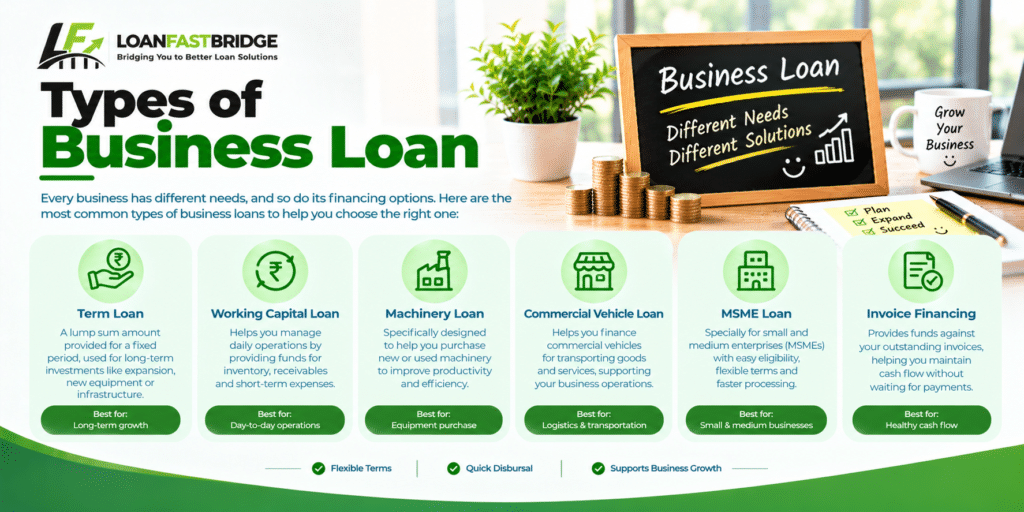
Different financing products address different commercial requirements. Understanding their features can help business owners choose a suitable option.
1. Term Loans
A term loan provides a specified amount that is repaid over an agreed period. Repayment commonly takes place through scheduled instalments, although the structure depends on the lender and agreement.
These facilities may be suitable for purchasing machinery, renovating premises, expanding production capacity, or funding other planned investments.
Before applying, calculate the expected return from the investment and compare it with the total borrowing cost.
2. Working Capital Loans
Working capital financing helps businesses manage short-term operational expenses, such as inventory purchases, supplier payments, and other recurring costs.
It can be particularly useful when a business has to pay suppliers before receiving money from customers.
Some working capital facilities operate through a revolving credit limit, while others provide a defined amount for a specific period.
Business owners should understand the repayment structure and avoid using short-term financing to cover persistent losses without addressing the underlying problem.
3. Business Lines of Credit
A line of credit provides access to funds up to an approved limit, subject to the product’s terms.
Depending on the arrangement, the borrower may draw funds when needed and pay interest according to the lender’s calculation method and outstanding balance.
This can provide flexibility for businesses with changing cash-flow requirements.
However, borrowers should check renewal conditions, fees, repayment requirements, and whether the available limit can change.
4. Machinery and Equipment Financing
Equipment financing is designed to help businesses acquire assets required for their operations.
Examples include manufacturing machinery, commercial vehicles, computers, specialised tools, and other eligible equipment.
Depending on the product, the purchased asset may serve as collateral. Borrowers should compare the expected useful life of the equipment with the repayment tenure to avoid paying for an asset long after it stops generating value.
5. Invoice Financing
Businesses sometimes deliver goods or services but have to wait for customers to pay their invoices.
Invoice financing can help eligible businesses access funds against qualifying unpaid invoices, subject to the provider’s terms and the creditworthiness of the relevant parties.
This may improve cash flow, but businesses should understand the applicable fees, recourse conditions, and consequences if an invoice remains unpaid.
6. Secured Business Financing
A secured facility requires collateral, which may include eligible property, deposits, equipment, or other accepted assets.
Offering security may influence the amount available and the terms offered, although approval is never guaranteed.
The major consideration is the risk associated with pledging an asset. If the borrower defaults and the lender lawfully enforces its security, the pledged asset may be at risk.
7. Unsecured Business Financing
An unsecured facility generally does not require conventional physical collateral.
Lenders may instead evaluate business revenue, banking history, credit records, profitability, repayment capacity, and the owner’s financial profile.
These products can be convenient for eligible borrowers who do not wish to pledge property. However, interest rates, fees, and eligibility conditions may differ from secured alternatives.
Who Is Eligible to Apply?
Eligibility varies between lenders and financing products. The lender may consider the following factors when evaluating an application.
Business Type
Eligible applicants may include proprietorships, partnerships, limited liability partnerships, private limited companies, and other permitted business entities.
The exact types accepted depend on the lender’s policy.
Business Vintage
Some lenders require the enterprise to have operated for a minimum period. Others may offer specialised financing to newer businesses under specific conditions.
Applicants should confirm whether their operating history meets the requirements.
Annual Turnover
Business revenue can help demonstrate commercial activity and repayment potential. Certain products may have minimum or maximum turnover requirements.
Profitability and Cash Flow
Lenders may assess whether the business generates sufficient income to meet its financial obligations.
A company with high sales but weak cash flow may still face repayment difficulties.
Credit History
The credit history of the business and, where relevant, its owners or guarantors may influence the lender’s assessment.
Existing defaults, excessive debt, and irregular repayment records can affect eligibility and the terms offered.
Banking and Financial Records
Lenders may examine bank statements, financial accounts, tax records, and other documents to understand the business’s financial position.
Meeting the basic criteria does not guarantee approval. Each application is assessed according to the lender’s underwriting policies and applicable requirements.
Documents Required for a Business Loan
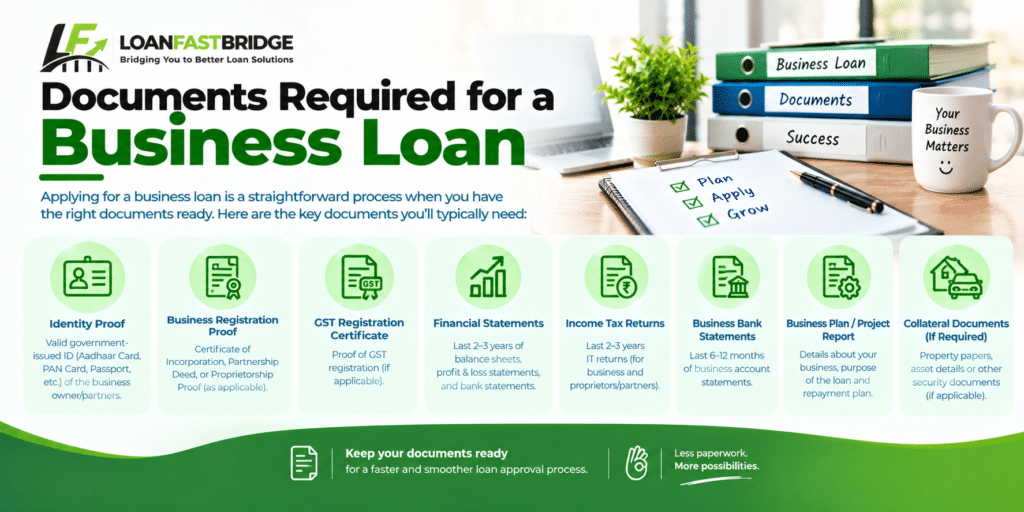
Preparing complete and accurate documents can make the application process more organised.
Commonly requested documents include:
- PAN and accepted identity documents of the applicant or authorised representatives.
- Address proof.
- Business registration documents, where applicable.
- GST registration and returns, where applicable.
- Bank statements for the period requested by the lender.
- Income-tax returns.
- Financial statements and profit-and-loss accounts.
- Details of existing loans and financial obligations.
- Business address and operating details.
- Ownership or partnership documents, where applicable.
- Information about the intended use of funds.
- Collateral documents, if the facility is secured.
Some lenders may request additional information, depending on the business structure, amount requested, and financing purpose.
For instance, a manufacturer seeking funds for machinery may need quotations or invoices for the equipment, while a working capital applicant may be asked to provide inventory or receivables information.
Business owners should submit genuine records and ensure that the information in their application matches the supporting documents.
How to Apply for a Business Loan
Although application procedures differ, the process generally follows several steps.
Step 1: Define Your Business Requirement
Determine exactly why the funds are needed. Establish whether the requirement relates to inventory, equipment, expansion, operating expenses, or another approved purpose.
Step 2: Calculate the Required Amount
Prepare a realistic estimate of the expense and identify any contribution the business can make from its own funds.
Avoid borrowing more than necessary.
Step 3: Review Your Financial Position
Calculate current revenue, operating expenses, existing debt repayments, cash reserves, and expected future income.
This helps you determine whether additional repayment obligations are manageable.
Step 4: Compare Lenders
Evaluate interest rates, fees, repayment tenure, collateral requirements, disbursement timelines, and other conditions.
Compare the total cost rather than relying exclusively on promotional rates.
Step 5: Prepare Documentation
Organise the required registration documents, bank statements, tax records, financial statements, and other supporting information.
Step 6: Submit the Application
Provide accurate information through the lender’s official website, authorised application, or branch.
Step 7: Complete Verification
The lender may review financial documents, assess credit history, evaluate business performance, and conduct other required checks.
Step 8: Review the Sanction Letter
If approved, carefully examine the amount, interest rate, repayment schedule, fees, collateral conditions, and other contractual requirements.
Step 9: Receive the Funds
Disbursement takes place according to the lender’s process and the agreed conditions.
Business owners should maintain records of the disbursement and use the funds for the permitted purpose.
Understanding Interest Rates and Charges
Interest represents the cost of borrowing money. The rate offered can depend on the lender, financing product, business performance, credit history, loan amount, security, and repayment tenure.
However, the interest rate alone does not reveal the complete borrowing cost.
Before accepting an offer, examine the following:
Interest rate: Check whether it is fixed or floating and how it is calculated.
Processing fees: Some lenders charge an upfront application or processing fee.
Documentation charges: Additional fees may apply depending on the product.
Collateral valuation charges: Secured facilities may involve asset valuation costs.
Insurance requirements: Check whether any insurance is mandatory or optional and understand the associated cost.
Late-payment charges: Missed payments may result in additional fees or other consequences.
Prepayment or foreclosure conditions: Confirm whether early repayment is permitted and whether charges apply.
Annual Percentage Rate (APR): Where disclosed, this can help compare the annualised cost of borrowing, including relevant charges.
Request a written repayment schedule before accepting the offer. It should clearly explain the instalment amount, payment dates, and other applicable obligations.
How Much Can a Business Borrow?
The approved amount depends on the product, lender’s policies, financial performance, repayment capacity, and whether collateral is offered.
Instead of selecting an amount based only on the maximum eligible limit, business owners should estimate the actual funding gap.
Consider a small business that requires ₹15 lakh to purchase inventory and meet operating expenses. If the owner can contribute ₹4 lakh from available business funds, the remaining requirement may be approximately ₹11 lakh.
The owner should then evaluate whether projected cash flow can support the repayments associated with that amount.
This is an illustrative example, not an estimate of lender eligibility.
The right amount should be determined by the business’s actual needs, realistic financial projections, and ability to repay under less favourable conditions.
Calculating EMI and Repayment Costs
Many term loans are repaid through equated monthly instalments (EMIs), which generally include both principal and interest.
The instalment amount depends on the principal borrowed, interest rate, repayment tenure, and calculation method.
For example, suppose a business borrows ₹5 lakh at an assumed annual interest rate of 12% for three years. Under a standard monthly reducing-balance calculation, the EMI would be approximately ₹16,607.
Across 36 months, the total scheduled payments would be approximately ₹5.98 lakh, before additional charges.
This illustration is not a lender quotation. Actual repayments may differ according to the interest calculation, payment dates, fees, and contractual terms.
A longer tenure generally reduces the monthly instalment but may increase the total interest paid. A shorter tenure may reduce the overall interest cost but require larger monthly payments.
Business owners should select a repayment schedule that remains manageable after accounting for operating expenses, taxes, employee salaries, supplier payments, and other commitments.
Benefits of Business Loan
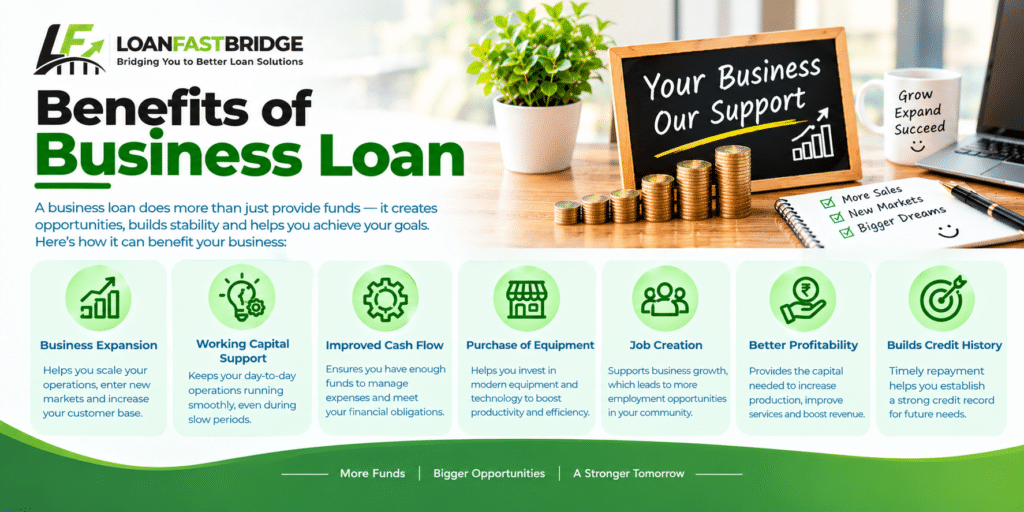
When selected carefully, external financing can help businesses address important operational and growth requirements.
Supports Business Expansion
Funding may help eligible enterprises open new locations, increase production, or enter additional markets.
Improves Cash-Flow Management
Working capital facilities can help bridge the gap between paying suppliers and receiving customer payments.
Helps Purchase Essential Equipment
Financing can spread the cost of machinery and other business assets over an agreed period.
Preserves Available Cash Reserves
Borrowing may allow a business to retain some of its existing funds for emergencies and routine expenses.
Helps Manage Seasonal Demand
Businesses with seasonal sales may require additional inventory or temporary working capital during busy periods.
Provides Different Financing Structures
Entrepreneurs may be able to choose from term loans, credit facilities, invoice financing, or other eligible products.
These advantages depend on the purpose of borrowing, the cost of financing, and the business’s ability to generate sufficient cash flow.
Risks and Mistakes to Avoid
Financing can support a business, but borrowing without adequate planning may create long-term financial pressure.
Borrowing More Than Necessary
A larger amount increases repayment obligations and may reduce the funds available for other business activities.
Ignoring Cash-Flow Problems
Borrowing to address a temporary timing gap may be reasonable in some cases. Repeated borrowing to cover persistent operating losses can make the underlying problem worse.
Choosing Only by Interest Rate
Processing fees, repayment tenure, collateral requirements, and early-closure conditions can significantly affect the overall cost.
Using Business Funds for Unplanned Personal Expenses
Using funds outside the permitted purpose can undermine the business plan and may breach the loan agreement.
Missing Repayments
Late payments may lead to penalties, collection activity, and adverse credit reporting. Secured borrowing may also put collateral at risk.
Ignoring Personal Guarantees
Some business facilities require a personal guarantee from an owner or another individual. The guarantor should understand the potential liability before signing.
Falling for Fraudulent Offers
Avoid anyone promising guaranteed approval in exchange for suspicious advance payments. Verify the lender’s identity and authorisation, and use official channels.
Government Schemes and Support for Businesses
In India, eligible micro and small enterprises may be able to access credit through government-supported programmes and lender partnerships.
One example is the Pradhan Mantri MUDRA Yojana (PMMY), which supports eligible income-generating microenterprises through participating lending institutions. Its categories include Shishu, Kishor, Tarun, and Tarun Plus, subject to scheme conditions. Tarun Plus is intended for eligible borrowers who have successfully repaid a previous Tarun-category loan.
Another option is the Credit Guarantee Fund Trust for Micro and Small Enterprises (CGTMSE), which provides credit guarantee support to eligible lending institutions for qualifying facilities to micro and small enterprises. It is a guarantee mechanism for lenders, not a direct loan from the trust to the business.
Eligibility, lending limits, coverage, and application procedures depend on the scheme’s current rules and the participating institution. Business owners should check official government resources and confirm the latest terms with their lender before applying.
Tips for Improving Your Chances of Approval
Although business loan approval cannot be guaranteed, good preparation can help lenders evaluate an application more clearly.
Maintain accurate financial records for your business loan. Keep bank statements, tax returns, sales information, and accounting records organised.
Separate personal and business transactions. Clear records make it easier to understand business performance when applying for a business loan.
Review your credit profile. Check for reporting errors and address overdue obligations where possible before taking a business loan.
Prepare a realistic business plan. Explain how the business loan funds will be used and how the investment is expected to support revenue or operations.
Borrow according to repayment capacity. A reasonable request supported by credible financial projections is more defensible than an unnecessarily large amount.
Disclose existing liabilities. Provide accurate information about current loans and other obligations.
Compare suitable lenders. Different institutions may serve different business profiles and financing needs.
Frequently Asked Questions
Can a new business apply for financing?
Some lenders offer a business loan products for new businesses, while others require an established operating history. Startup applicants for a business loan may need a detailed business plan, financial projections, promoter contributions, and other supporting documents.
Can self-employed individuals apply?
Yes. Eligible self-employed individuals and business owners can apply for suitable business loan products, subject to the lender’s criteria and documentation requirements.
Is collateral always required?
No. Some business loan facilities are secured, while others may be available without conventional collateral. Approval, pricing, and eligibility for a business loan depend on the lender and product.
How long does approval take?
Processing time for a business loan varies according to the lender, application completeness, verification requirements, and financing product. Confirm the expected business loan timeline directly with the institution.
Can funds be used for personal expenses?
The permitted use of a business loan depends on the agreement. Funds approved as a business loan for business purposes should be used according to the stated conditions rather than diverted to unrelated personal expenses.
Does applying affect my credit score?
A formal business loan application may result in a credit enquiry, depending on the lender’s process. Multiple unnecessary business loan applications should be avoided.
Can I repay the loan early?
Early repayment of a business loan may be permitted, but the agreement may specify conditions or charges. Ask the lender for a written settlement calculation before closing your business loan facility.
Conclusion
Access to suitable business loan can help entrepreneurs manage working capital, purchase equipment, expand operations, and respond to new commercial opportunities. However, taking a business loan should always be supported by a clear purpose and a realistic repayment plan.
Before applying for a business loan calculate the amount required, review your business finances, compare available lenders, and examine the interest rate, fees, tenure, and collateral conditions. Consider how business loan repayments will affect cash flow under both expected and less favourable business conditions.
Government-supported programmes may provide additional options for eligible enterprises seeking a business loan but applicants should verify the current eligibility requirements and terms before proceeding.
At LoanFastBridge, informed financial decisions regarding a business loan begin with understanding the available options and their long-term implications. The most suitable business loan arrangement is not necessarily the one offering the largest amount; it is the one that addresses the business requirement while keeping repayments manageable.
Plan your business loan funding carefully, compare lenders responsibly, and choose financing that supports sustainable business growth.