Gold has long been an important financial asset for Indian households. Many families purchase gold jewellery for weddings, festivals, savings, and long-term financial security. However, there may be times when immediate funds are required for medical expenses, household needs, business requirements, or other important financial commitments.
In such situations, a gold loan can provide access to funds by using eligible gold jewellery or ornaments as security. Instead of selling gold to meet an immediate expense, the borrower can pledge it with a lender and repay the borrowed amount according to the agreed terms.
Although this financing option can be convenient, it also involves financial responsibilities and the risk of losing pledged gold if the loan is not repaid as required. Understanding the eligibility criteria, valuation process, interest rates, repayment methods, and applicable rules is therefore essential before applying.
This comprehensive guide explains how gold-backed borrowing works in India and how borrowers can evaluate whether it is suitable for their financial circumstances.
What Is a Gold Loan?
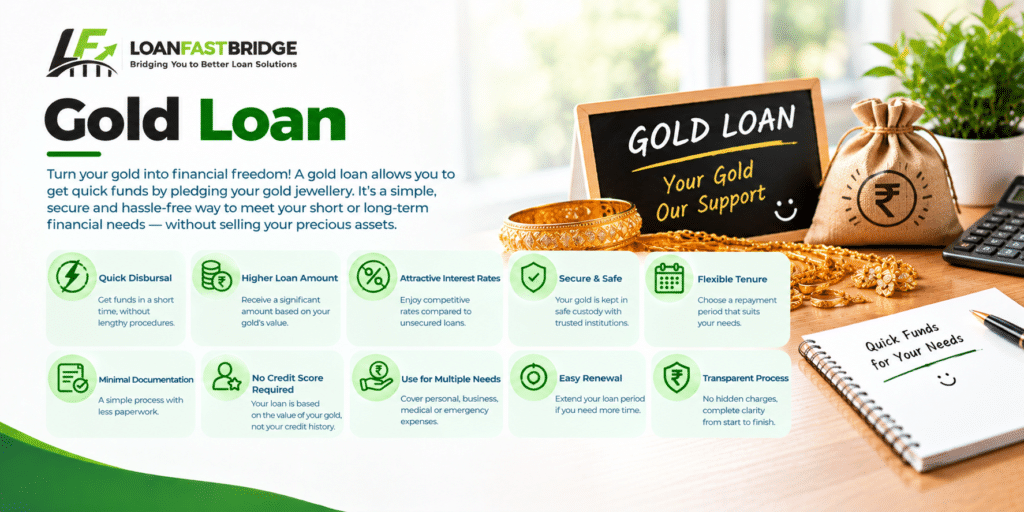
A gold loan is a secured credit facility in which a borrower pledges eligible gold jewellery or ornaments to a bank or a non-banking financial company (NBFC) in exchange for money.
The lender evaluates the eligible gold, determines its lending value according to applicable rules, and offers a loan based on the assessment and its lending policy.
Once the loan is approved, the borrower receives the sanctioned amount and agrees to repay the principal and applicable interest within the specified period.
After all required dues have been settled and the lender’s release procedures have been completed, the pledged gold is returned to the borrower.
For example, suppose a family needs ₹1.5 lakh to manage an urgent expense. If the family owns eligible gold jewellery, it may be able to use that asset as security instead of selling it.
The actual amount available depends on the gold’s purity, eligible net weight, applicable valuation method, permitted loan-to-value ratio, and the lender’s terms.
A gold-backed facility is secured borrowing, not free money. The borrower remains responsible for repayment, and the pledged asset may be at risk if the contractual obligations are not met.
Why Do People Choose Gold Loans?
Many Indian households own gold but may not have sufficient liquid savings available when an unexpected expense arises. Selling jewellery can be emotionally difficult, particularly when it has sentimental or family value.
A gold loan offers an alternative by allowing eligible gold to be used as collateral for a temporary financial requirement.
Common reasons for considering this financing option include:
- Medical or emergency expenses.
- Household repairs and essential purchases.
- Short-term business working capital.
- Agricultural expenses, where the lender offers an eligible product.
- Education-related expenses, subject to the loan’s permitted purpose.
- Temporary cash-flow difficulties.
- Other eligible personal or business requirements.
Approval may be relatively straightforward when compared with certain unsecured products because the lender holds eligible collateral. However, the borrower must still satisfy the lender’s documentation, verification, repayment, and other requirements.
The suitability of this option depends on the urgency of the expense, the cost of borrowing, and the borrower’s ability to repay on time.
How Does a Gold Loan Work?
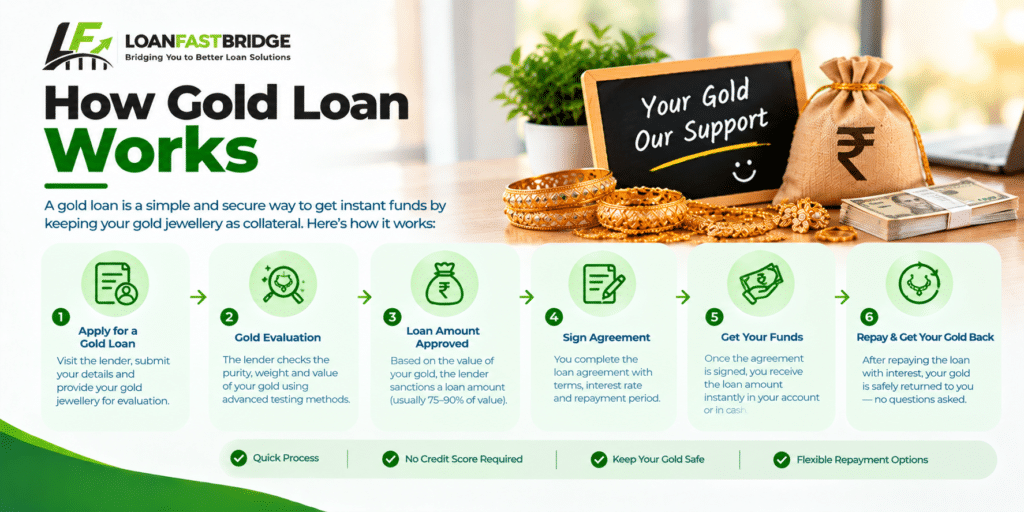
The process typically follows several steps.
Step 1: Assess Your Financial Requirement
Determine how much money you actually need for your gold loan. Avoid borrowing the maximum amount simply because the lender offers it.
Step 2: Select a Lender
Compare banks and regulated NBFCs that provide gold-backed financing or a gold loan. Review their interest rates, charges, repayment options, loan tenure, and gold loan release procedures.
Step 3: Submit Your Gold for Evaluation
The lender examines the pledged jewellery for a gold loan to determine its eligible net gold weight and purity. Non-gold components, stones, beads, and other materials may be excluded from the gold loan valuation.
Step 4: Complete the Documentation
Provide the required identity, address, and other documents needed for a gold loan. The lender may also request information about the gold loan purpose and repayment arrangements.
Step 5: Receive the Loan Offer
The lender determines the eligible gold loan amount based on the valuation, applicable loan-to-value limits, internal policies, and other relevant factors.
Step 6: Review and Accept the Agreement
Check the interest rate, repayment schedule, fees, default conditions, and terms governing the return of the pledged gold for your gold loan.
Step 7: Receive the Funds
After approval and completion of the required formalities,your gold loan money is disbursed according to the lender’s process.
Step 8: Repay and Recover Your Gold
Make the required gold loan payments according to the agreement. Once all outstanding gold loan obligations are settled, follow the lender’s procedure to collect the pledged jewellery.
Always obtain documentation showing the gold items pledged, their assessed details, and the applicable loan terms.
Who Is Eligible for a Gold Loan?
Eligibility requirements vary among lenders, but applicants commonly need to satisfy certain basic conditions.
Age Requirements
The applicant must meet the lender’s minimum age requirement and any other applicable eligibility conditions.
Ownership of Eligible Gold
Applicants must provide gold that the lender is permitted to accept as collateral. Jewellery and ornaments may qualify, while certain coins or other forms of gold may be subject to additional restrictions.
Identity Verification
Lenders generally require accepted identity and address documents to verify the applicant.
Repayment Capacity
Although the gold serves as security, borrowers must still be able to repay the principal and interest. Some lenders may evaluate income, financial circumstances, or the stated purpose of borrowing.
Completion of Required Formalities
Applicants must complete the lender’s valuation, documentation, and agreement procedures before the loan can be disbursed.
Meeting these basic requirements does not guarantee approval. The lender makes the final decision according to its policies and applicable regulations.
What Types of Gold Can Be Pledged?
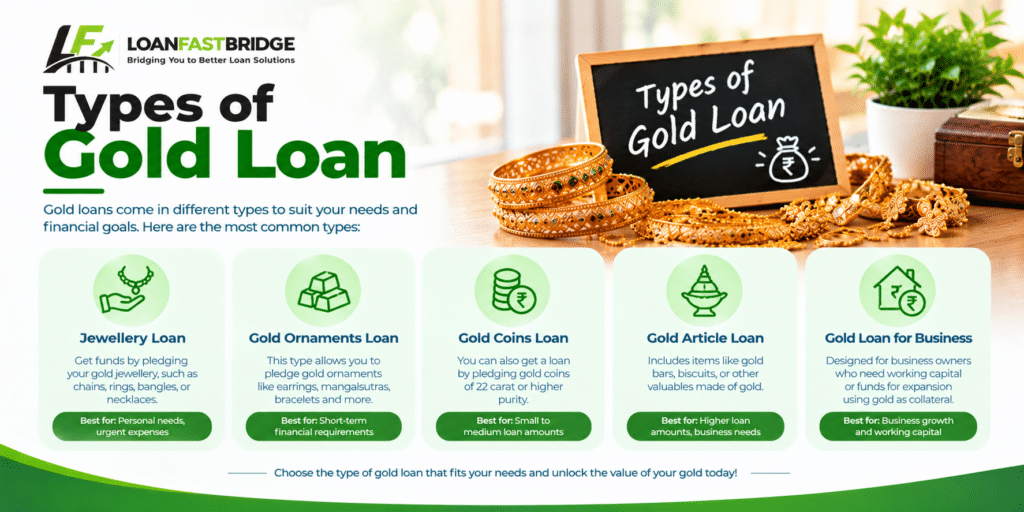
The types of gold accepted depend on the lender’s product and applicable rules.
Gold Jewellery
Gold jewellery is a common form of collateral. The lender assesses its purity and eligible gold content before calculating the lending value.
Gold Ornaments
Eligible ornaments may be accepted if they satisfy the lender’s requirements.
Gold Coins
Some lenders accept certain gold coins within prescribed limits, while others may impose specific restrictions on the type, source, or quantity accepted.
Other Gold Items
Acceptance of bars, bullion, or other gold products depends on the lender and the applicable regulatory framework.
Gold-plated products and jewellery made from non-gold materials do not qualify simply because they look like gold.
Borrowers should confirm which items are acceptable before visiting the lender.
Understanding Gold Purity and Valuation
The amount a lender offers is influenced by the quantity and purity of the eligible gold.
Gold purity is commonly expressed in karats. For example, 24-karat gold is considered nearly pure gold, while 22-karat gold contains a smaller proportion of other metals.
Jewellery may include stones, decorative components, clasps, or other materials that do not qualify as gold for valuation purposes.
During the assessment, the lender generally considers:
- The eligible net weight of the gold.
- The assessed purity.
- The applicable gold price used for valuation.
- The permitted loan-to-value ratio.
- The lender’s product conditions and other applicable requirements.
For illustration, imagine that the eligible gold content of your jewellery is valued at ₹2 lakh under the lender’s applicable valuation method. If the permitted loan-to-value ratio is 75%, the maximum amount based on that valuation would be ₹1.5 lakh, subject to the lender’s assessment and other conditions.
This is an illustrative calculation, not a guaranteed offer. Actual valuations and permitted amounts may differ.
The jewellery’s original purchase price, sentimental value, making charges, and retail mark-up generally do not determine the lending amount in the same way as eligible gold content.
Gold Loan Interest Rates and Charges
Interest is the cost of borrowing money, and the rate can vary considerably between lenders and products.
Factors that may influence the offer include the loan amount, repayment tenure, interest calculation method, repayment structure, and lender policy.
When comparing offers, consider more than the advertised interest rate.
Interest Rate
Check whether the rate is fixed or variable and whether interest is calculated on the outstanding balance or under another stated method.
Processing Fees
Some lenders charge an upfront fee for processing the application.
Valuation Charges
The lender may charge for assessing the pledged gold, depending on its product terms.
Documentation and Other Fees
Additional charges may apply under the agreement.
Late-Payment Charges
Missed payments may result in penalties or other consequences.
Auction-Related Costs
If the account defaults and the pledged gold is auctioned according to the agreement and applicable rules, costs and procedures may affect the settlement.
Ask the lender for a written explanation of all applicable charges before accepting the offer.
Loan-to-Value Ratio: How Much Can You Borrow?
The loan-to-value ratio, commonly called LTV, compares the loan amount with the eligible value of the pledged gold.
For example, if the eligible gold value is ₹1 lakh and the permitted LTV is 75%, the amount calculated at that ratio would be ₹75,000.
The Reserve Bank of India (RBI) issued revised directions for gold and silver collateral loans in June 2025, with implementation requirements applying according to the prescribed transition provisions. Under the framework, the maximum LTV for consumption loans varies by loan amount: up to 85% for loans of ₹2.5 lakh or less, up to 80% for loans above ₹2.5 lakh and up to ₹5 lakh, and up to 75% for loans above ₹5 lakh. These are regulatory ceilings for covered loans, not guaranteed offers, and the framework contains additional conditions. Borrowers should confirm the applicable rules and the lender’s current product terms before applying.
The lender may offer a lower amount based on its valuation, risk assessment, product conditions, and other requirements.
Borrowers should avoid assuming that the entire market value of their gold can be borrowed.
Repayment Options for Gold Loans
Different lenders provide different repayment structures. Understanding these options helps borrowers choose a plan that matches their cash flow.
Regular EMI Repayment
Under a standard instalment arrangement, borrowers make scheduled payments that may include both principal and interest.
This structure can help borrowers plan their monthly budget because the instalment schedule is defined in advance.
Interest Payments During the Tenure
Some products allow borrowers to pay interest periodically and repay the principal according to the agreed schedule.
This can reduce the immediate payment burden in some situations, but borrowers should check when the principal becomes due and whether the arrangement is suitable for their income.
Bullet Repayment
Certain products may allow the principal and interest to be paid at the end of the agreed period, subject to the lender’s terms and applicable regulations.
This structure can involve a substantial payment at maturity. Borrowers should not choose it unless they have a realistic plan to arrange the required funds.
Part-Payment or Early Closure
Some lenders permit borrowers to repay part or all of the outstanding amount before the scheduled maturity date. Charges and conditions may apply.
Before accepting any repayment arrangement, calculate the total amount payable and ensure you can meet the obligations without depending on uncertain future income.
Benefits of a Gold Loan
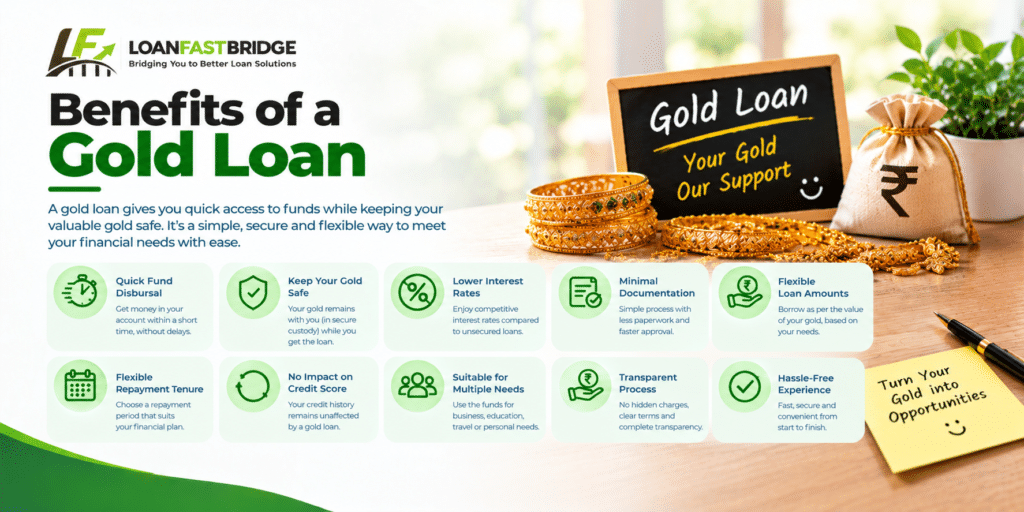
When used carefully, gold-backed borrowing can offer several practical advantages.
Access to Funds Using Existing Assets
Borrowers can use eligible gold as collateral without necessarily selling it.
Secured Financing
Because the loan is backed by an asset, eligibility and pricing may differ from those of unsecured credit products.
Potentially Faster Processing
Some lenders offer relatively quick valuation and disbursement processes once documentation and verification are complete. Actual timelines vary.
Multiple Repayment Structures
Depending on the lender, borrowers may be able to choose from different repayment options.
Useful for Short-Term Financial Needs
This type of financing may be appropriate when the borrower has a defined funding requirement and a credible repayment plan.
Continued Ownership Subject to Repayment
The borrower can recover the pledged gold after settling all applicable dues and completing the release process.
These advantages should be weighed against interest costs, fees, the risk of default, and the importance of the pledged jewellery to the family.
Risks You Should Understand Before Applying
A gold loan can help meet an urgent financial need, but it also creates risks that borrowers should consider carefully.
Risk of Losing Pledged Gold
If the borrower fails to repay and the account reaches the stage where the lender is entitled to enforce its security, the pledged gold may be auctioned in accordance with the agreement and applicable rules.
For jewellery with sentimental or family significance, this risk deserves particular attention.
Interest Accumulation
Interest and other charges can increase the amount required to close the loan. Borrowers should monitor their outstanding balance rather than focusing only on the original amount received.
Short Repayment Periods
Some products have relatively short tenures. If the borrower cannot arrange the required funds by maturity, repayment may become difficult.
Borrowing Against More Gold Than Necessary
A larger loan can create a greater repayment burden. Borrow only the amount required for the identified expense.
Gold Price Fluctuations
Gold prices can change over time. Although the loan is assessed according to the applicable valuation method, market movements may affect the value of the pledged asset and the lender’s risk management.
Unclear Terms and Unauthorised Agents
Borrowers should avoid signing incomplete documents or handing gold to unauthorised intermediaries. Use official lender channels and obtain a proper receipt for every pledged item.
Gold Loan vs Personal Loan
Both products can provide access to funds, but they work differently.
A gold loan requires eligible gold as collateral. A personal loan is often unsecured and is generally assessed using income, credit history, employment, and other financial information.
Gold-backed borrowing may suit a person who owns eligible gold and needs funds for a defined period. A personal loan may suit someone who does not want to pledge an asset and qualifies for an unsecured facility.
The interest rate alone should not determine the decision. Compare the total cost, processing time, repayment tenure, collateral risk, and other contractual terms.
Most importantly, consider whether you could comfortably repay the borrowing if your income changes or an unexpected expense occurs.
Gold Loan vs Education Loan
A gold loan and an education loan serve different financial purposes.
A gold-backed facility uses eligible gold as security and may be considered for a range of permitted expenses, depending on the lender and applicable rules.
An education loan is designed to finance eligible educational expenses, such as tuition fees and certain course-related costs. It may provide repayment arrangements linked to the study period and other conditions specified by the lender.
Some education-related borrowing may also qualify for government assistance if the applicant satisfies the relevant eligibility requirements.
Students and families should compare the financing options according to the purpose, total cost, repayment schedule, and risk to their assets. Pledging family jewellery for educational expenses should be considered only after evaluating alternatives and confirming a realistic repayment plan.
How to Choose the Right Gold Loan Provider
Choosing a reliable lender is an important part of protecting your financial interests and pledged gold.
Verify the Lender
Confirm that the bank or NBFC is appropriately authorised and that the product is offered through an official channel.
Compare the Total Cost
Review interest rates, processing fees, valuation charges, taxes, and other applicable costs.
Understand the Repayment Terms
Check the maturity date, payment frequency, principal repayment requirements, and consequences of delayed payment.
Check Gold Storage and Security Procedures
Ask how pledged jewellery is documented, stored, insured where applicable, and released after repayment.
Read the Default and Auction Conditions
Understand the notices, procedures, and other contractual provisions that may apply if you cannot repay.
Obtain Written Documentation
Keep the valuation details, item inventory, sanction letter, agreement, and payment receipts.
Avoid Pressure-Based Decisions
Do not pledge jewellery simply because an agent promises instant approval or an unusually high loan amount. Take time to compare options and understand the agreement.
Tips for Managing a Gold Loan Responsibly
A clear repayment plan can help reduce financial stress and protect your pledged asset.
Borrow only what you need. Calculate the actual expense and avoid using the available loan limit as your spending target.
Choose a realistic tenure. Make sure the repayment period matches your income and expected cash flow.
Keep an emergency reserve. Avoid committing every available rupee to loan repayment if doing so would leave you unable to meet essential expenses.
Set payment reminders. Track instalment dates and maturity deadlines.
Read every clause. Understand the interest calculation, late-payment charges, renewal conditions, and auction procedures.
Contact the lender early if you face difficulty. Ask about available options before the account becomes seriously overdue. Any modification or extension will depend on the lender’s policies and applicable rules.
Collect your gold promptly after closure. Follow the lender’s documented release procedure and check the returned items against the original inventory.
Keep all records. Store the closure confirmation and other relevant documents safely.
Frequently Asked Questions
Can I get a gold loan without a salary slip?
Possibly. Requirements differ among lenders and products. Some may request other information to verify identity, eligibility, or repayment capacity. Confirm the documentation required before applying.
Does the lender accept gold with stones?
The lender may accept jewellery containing stones, but the stones and non-gold components are generally excluded from the eligible gold weight used for valuation. The final assessment depends on the lender’s procedure.
Can I repay a gold loan before maturity?
Early repayment may be permitted, subject to the agreement and applicable charges or conditions. Request an updated settlement amount from the lender before making the final payment.
What happens if I cannot repay on time?
Interest, overdue charges, and other contractual consequences may apply. If the account remains unpaid, the lender may eventually enforce its security and auction the pledged gold in accordance with applicable rules. Contact the lender promptly if you anticipate difficulty.
Can I renew my gold loan?
Some lenders offer renewal or extension options, but approval is not automatic. It may depend on the outstanding balance, account status, valuation, and current product conditions.
Is a gold loan better than selling gold?
It depends on your circumstances. A loan allows you to retain the possibility of recovering the jewellery after repayment, but it creates an interest-bearing obligation and carries a risk of losing the pledged gold. Selling gold avoids loan repayment but permanently transfers ownership of the items sold.
How long does approval take?
Some applications can be processed quickly, but actual timelines depend on valuation, documentation, verification, lender procedures, and other requirements. No particular approval time should be assumed without confirmation from the lender.
Conclusion
A gold loan can be a useful financial option for individuals who need funds and own eligible gold jewellery or ornaments. It allows them to access credit without immediately selling an asset that may hold financial, cultural, or sentimental value.
However, responsible borrowing begins with understanding the total cost and the consequences of non-payment. Before applying, compare lenders, verify the valuation, check the interest rate and charges, and choose a repayment structure that fits your financial circumstances.
Borrowers should also understand the applicable loan-to-value limits, keep complete documentation, and read the agreement carefully before pledging their jewellery.
For LoanFastBridge readers, the most important principle is to select financing according to the actual requirement rather than the maximum amount available. Whether you are comparing secured borrowing, personal financing, or options for an education-related expense, review the alternatives and their long-term implications before making a decision.
Gold can provide financial support when used thoughtfully, but protecting that asset requires a clear repayment plan and a full understanding of the agreement.
Make an informed borrowing decision: compare your options, understand the risks, and borrow only what you can reasonably repay.
Disclaimer: This article is for general educational purposes and does not constitute personalised financial advice. Interest rates, eligibility, valuation methods, loan-to-value limits, charges, and repayment conditions vary by lender and may change. Confirm the current terms with the relevant financial institution and review applicable RBI directions before proceeding