
Managing a major expense can sometimes require more funds than you currently have available. Whether the need involves education, medical treatment, home improvement, a wedding, travel, or another legitimate personal requirement, borrowing can provide access to funds without waiting years to build the entire amount through savings.
Among the financing options available in India, an unsecured personal loan is commonly considered because it generally does not require property or another major asset as collateral. Instead, lenders assess factors such as income, credit history, employment or business stability, existing financial commitments, and repayment capacity.
However, borrowing money is a financial commitment. A convenient application process or attractive advertised rate should not be the only reason for choosing a particular offer. Understanding the complete cost, repayment schedule, eligibility conditions, and applicable charges is essential before making a decision.
This guide explains how personal loans work, who may qualify, how interest and EMIs are calculated, what documents may be required, and how borrowers can compare available options responsibly.
What Is a Personal Loan?
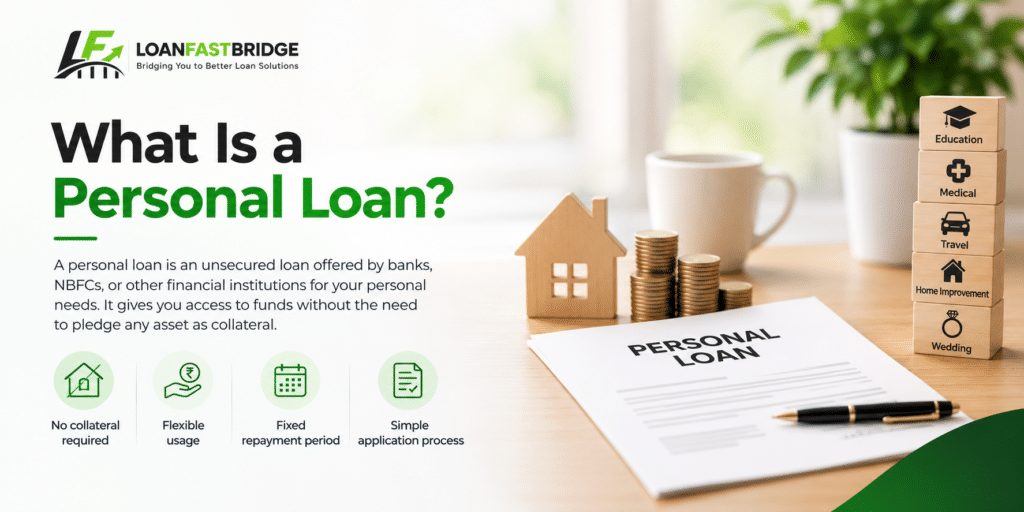
A personal loan is generally an unsecured credit facility offered by a bank, NBFC, or other eligible financial institution to borrowers who meet its requirements.
Unlike a home loan, where financing is connected to a property, or a vehicle loan, where the financing is linked to a car or other eligible vehicle, this type of borrowing is generally not secured against a specific asset.
The personal loan lender instead evaluates the applicant’s financial profile and determines whether the requested amount and repayment terms are appropriate.
Depending on the lender’s policies, the funds may be used for various permitted personal requirements. The borrower repays the amount through scheduled instalments over an agreed tenure.
The actual interest rate, maximum amount, repayment period, fees, and eligibility requirements vary between lenders.
Therefore, an offer that works well for one borrower may not necessarily be suitable for another.
How Does a Personal Loan Work?
The personal loan process usually starts with an application submitted to a lender. The applicant provides information about income, employment or business activity, existing financial obligations, identity, and other relevant details.
The lender reviews this information and may verify the documents and information provided for personal loan.
If the application meets the lender’s requirements, the applicant may receive an approval or sanction specifying important terms such as:
- Approved amount
- Interest rate
- Repayment tenure
- Monthly instalment
- Processing charges
- Applicable taxes or other fees
- Prepayment or foreclosure conditions
- Other terms and conditions
Once the required formalities are completed, the approved amount may be disbursed according to the lender’s process.
Repayment generally takes place through monthly instalments. Each instalment typically contains a principal component and an interest component.
The exact structure depends on the personal loan agreement.
When Can This Type of Borrowing Be Useful?
An unsecured credit facility can be considered when a borrower has a genuine financial requirement and sufficient repayment capacity.
Personal loan Common situations include the following.
Medical or Emergency Expenses
Unexpected medical costs can put pressure on household finances. If available savings are insufficient, eligible borrowers may consider external financing.
However, it is important to assess whether the resulting monthly obligation remains manageable after the immediate situation is resolved.
Education Expenses
Some people use personal borrowing for certain education-related costs. Before doing so, it can be useful to compare dedicated education financing, scholarships, savings, or other suitable alternatives.
Wedding Expenses
Weddings can involve substantial spending on venues, travel, accommodation, services, and other arrangements. Financing may help spread these costs, but borrowers should consider whether taking on a longer repayment commitment for a short-term event is financially sensible.
Home Improvement
Renovation, repairs, furniture, appliances, and other improvements can sometimes require additional funds. Depending on the size and purpose of the project, borrowers may compare unsecured borrowing with other financing options.
Travel and Planned Purchases
Some borrowers use credit for significant planned expenses. While this can provide immediate purchasing capacity, discretionary spending should be financed carefully because the repayment obligation continues after the purchase has been completed.
Debt Consolidation
In certain circumstances, borrowers may consider combining multiple debts into one arrangement.
This can potentially simplify repayment, but consolidation does not remove the underlying debt. It is worthwhile only when the new arrangement provides a genuine financial advantage after considering interest, fees, tenure, and total repayment.
Who Can Apply for a Personal loan?
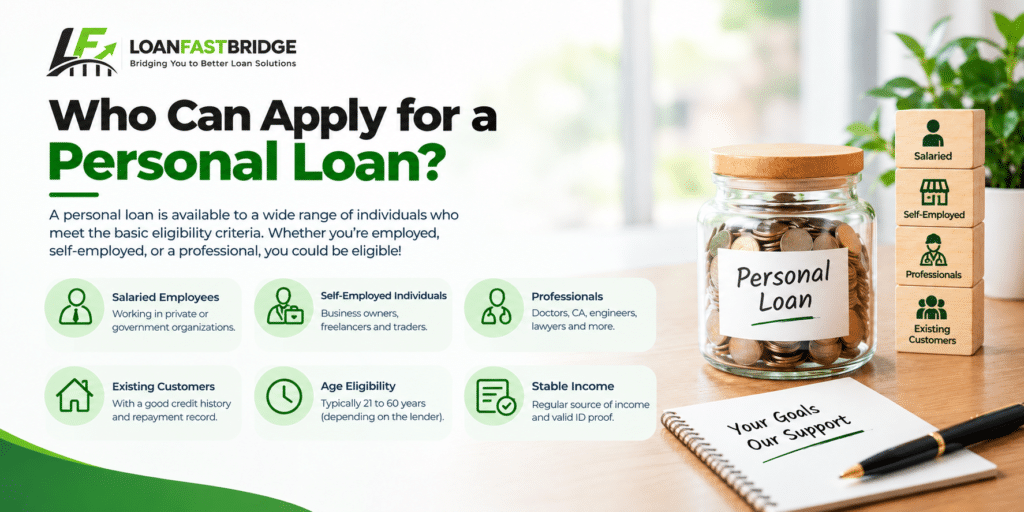
Eligibility criteria vary between financial institutions. There is no single set of conditions that guarantees approval across all lenders.
Factors commonly considered include:
- Age
- Monthly or annual income
- Employment history
- Business stability
- Credit history
- Existing debt
- Current EMIs
- Banking activity
- Requested amount
- Repayment capacity
- Employer or professional profile
Both salaried and self-employed applicants may be considered, subject to the relevant lender’s requirements.
It is important to understand that meeting basic criteria does not guarantee approval. The final decision depends on the lender’s internal assessment, verification, policies, and applicable regulations.
Credit Score and Its Importance
Your credit history can have an important role in the assessment process in personal loan.
Credit information records borrowing and repayment behaviour reported by financial institutions. A history of making repayments on time can demonstrate responsible credit management.
On the other hand, repeated missed or delayed payments may negatively affect your credit profile.
Before submitting an application, consider checking your credit report for potential errors. If you identify incorrect information, resolving it before applying may be useful.
A credit score is not the only factor lenders consider. Income, existing obligations, employment or business stability, banking history, and other information can also influence the assessment.
Personal Loan Interest Rates
The interest rate determines the cost of borrowing over the repayment period.
Rates can differ considerably between lenders and applicants because financial institutions assess risk differently.
Factors that may influence pricing include:
- Credit history
- Income
- Existing liabilities
- Employment or business profile
- Requested amount
- Repayment period
- Relationship with the lender
- Internal risk assessment
An advertised “starting rate” should not be assumed to be the rate every customer will receive.
Always check the actual rate included in your offer and understand how it affects the total repayment amount.
How Is Personal Loan EMI Calculated?
EMI means Equated Monthly Instalment. It is the amount scheduled for repayment at regular intervals, generally each month.
Three major variables influence the instalment:
Principal: The amount borrowed.
Interest rate: The cost charged by the lender for providing the funds.
Tenure: The period available to repay the amount.
A longer tenure generally reduces the monthly instalment because the repayment is spread over more months. However, it can increase the total interest paid.
A shorter tenure generally increases the monthly obligation but may reduce the overall interest cost.
For this reason, borrowers should evaluate both monthly affordability and total repayment.
Example
Imagine a borrower needs ₹5 lakh and is comparing two repayment periods.
A longer tenure may make the monthly payment easier to manage, but the borrower could pay interest for a longer period.
A shorter tenure may require a larger monthly payment while reducing the period during which interest accumulates.
The appropriate option depends on income, existing expenses, financial goals, and available cash flow.
Using an EMI calculator before applying can help you compare different combinations of amount, interest rate, and tenure.
Why the Lowest EMI Is Not Always the Best Choice
A low monthly payment can appear attractive, but it does not necessarily mean the borrowing arrangement is inexpensive.
For example, extending the tenure can reduce the monthly instalment while increasing the number of payments.
Before choosing an offer, review:
- Monthly instalment
- Total interest
- Processing fee
- Other applicable charges
- Repayment duration
- Total amount payable
The objective should be to find a repayment structure that is comfortable without unnecessarily increasing the total cost.
Documents Required for a Personal Loan
Documentation depends on the lender and applicant profile.
Salaried applicants may commonly be asked for:
- Identity proof
- Address proof
- PAN or applicable identification
- Recent salary slips
- Bank statements
- Employment information
- Other income-related documents
Self-employed applicants may additionally need:
- Business details
- Bank statements
- Income-tax documents
- Financial statements
- Proof of business continuity
- Other documents requested by the lender
Additional documentation may be requested during verification.
All information submitted should be accurate and consistent. Providing false documents or misleading information can result in rejection and may create more serious consequences.
Personal Loan for Salaried Employees
Salaried individuals often have relatively predictable monthly income, which can make budgeting easier.
However, lenders may consider more than salary alone. Employer profile, employment continuity, existing liabilities, credit history, and banking information can all be relevant.
Before applying, calculate your current monthly commitments in personal loan.
For example, if you already have rent, education expenses, credit-card payments, vehicle EMIs, and household costs, adding another instalment may significantly reduce your disposable income.
A useful approach is to calculate your monthly cash flow first and determine what repayment amount can reasonably be accommodated.
Personal Loan for Self-Employed Individuals
Business owners and self-employed professionals can also seek unsecured financing, subject to lender requirements.
Because business income can fluctuate, lenders may request additional information to understand financial stability.
Applicants may be asked for bank statements, tax records, financial statements, or business-related documents.
Self-employed borrowers should use realistic income figures when planning repayment. It is risky to assume that unusually strong business months will continue throughout the entire repayment period.
Secured and Unsecured Borrowing: What’s the Difference?
Understanding this distinction can help you select an appropriate product.
Unsecured Financing
An unsecured facility generally does not require property or another asset to be pledged as collateral.
The lender primarily evaluates the borrower’s financial and credit profile.
Secured Financing
A secured facility involves an asset being offered as security.
Examples can include:
- Home loans
- Loans against property
- Many vehicle financing arrangements
Because collateral is involved, the structure, eligibility requirements, and consequences of default can differ from unsecured borrowing.
Neither structure is automatically better. The suitable option depends on the purpose, amount required, financial profile, and repayment capacity.
Advantages of personal loan
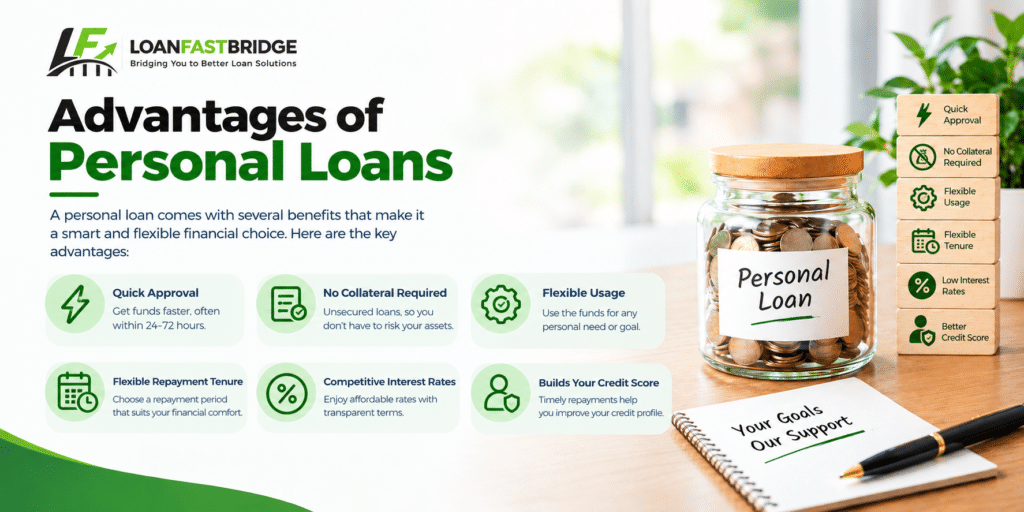
Unsecured personal borrowing can have several potential benefits for eligible applicants.
No Major Asset Usually Required
Because collateral is generally not required, borrowers do not normally need to pledge a house or another valuable asset.
Flexible Purpose
Subject to lender terms, the funds may be used for various permitted personal requirements rather than being restricted to one specific asset.
Structured Repayment
Regular instalments can make it easier to incorporate the borrowing into a monthly budget.
Digital Application Options
Many lenders provide online application and document-submission facilities. Processing speed varies according to the lender, applicant, documentation, and verification requirements.
Important Costs to Check
The interest rate is only one part of the total cost.
Before accepting an offer, check for:
Processing Fee
Some lenders charge a fee for processing the application.
Documentation Charges
Certain lenders may apply additional documentation-related costs.
Taxes
Applicable taxes may be charged on specific fees or services.
Late-Payment Charges
Failure to make payments according to the agreed schedule may result in additional charges.
Prepayment or Foreclosure Charges
If you plan to close the account early, check whether any charges or conditions apply.
The exact fee structure varies by lender and product. Always refer to the official loan documentation.
Common Mistakes to Avoid
Borrowing More Than Necessary
A larger approved amount does not mean you need to use all of it. Borrow only what is required for the intended purpose.
Focusing Only on the Interest Rate
A low rate can be attractive, but the overall cost also depends on fees and tenure.
Ignoring Existing Obligations
Adding another monthly commitment without considering current debt can put pressure on your finances.
Choosing an Excessively Long Tenure
Lower instalments can come with higher cumulative interest.
Missing Repayments
Late payments can result in charges and may negatively affect your credit history.
Submitting Incorrect Information
Applications should contain accurate information about income, employment, existing liabilities, and identity.
Accepting Without Reading
Never rely solely on a verbal explanation. Review the sanction letter and final agreement before accepting the facility.
How to Improve Your Chances of Getting a Personal Loan
There is no guaranteed method for getting approval, but responsible financial management can strengthen an application.
Maintain Timely Repayments
Pay existing loans and credit-card balances according to their agreed schedules.
Manage Existing Debt
A high level of existing obligations can affect your repayment capacity.
Keep Financial Records Organised
Maintain accurate income, tax, banking, and employment records.
Check Your Credit Report
Review your credit information periodically and address inaccuracies when identified.
Request a Sensible Amount
Borrowing an amount that aligns with your income and requirement can make the application more realistic.
Avoid Unnecessary Applications
Do not submit multiple applications simply to see which lender approves you. Compare eligibility requirements first and apply selectively.
How to Compare Different Offers
A proper comparison should consider more than the advertised interest rate.
Use this checklist:
| Factor | What to Check |
|---|---|
| Interest rate | Actual rate offered to you |
| Amount | Whether it covers your genuine requirement |
| Tenure | Total repayment period |
| EMI | Monthly affordability |
| Processing fee | Upfront or deducted from disbursement |
| Total repayment | Principal plus applicable interest and charges |
| Prepayment | Conditions and applicable fees |
| Late payment | Consequences of missed instalments |
| Documentation | Required paperwork |
| Lender reputation | Transparency and service standards |
Comparing these factors gives you a more complete understanding of the offer.
How Loan Consultancy Can Help With Personal Loans
Researching different lenders independently can take considerable time. Eligibility criteria, rates, documentation requirements, and processing procedures can differ significantly.
A professional loan consultancy can help simplify the process by assisting with:
- Understanding your basic requirements
- Reviewing preliminary eligibility
- Identifying potentially suitable options
- Explaining documentation
- Organising application information
- Comparing relevant terms
- Navigating the application process
However, a consultant cannot guarantee approval, a particular interest rate, or a specific loan amount.
The final decision rests with the lender after its assessment and verification.
Borrowers should also review the official offer and final agreement directly before accepting any financing.
Why Choose Loanfastbridge for Personal Loan Assistance?
Loanfastbridge aims to make the borrowing journey easier to understand for customers exploring different financing options.
Rather than focusing only on obtaining approval, the process should begin by understanding the borrower’s actual requirement, financial position, and repayment capacity.
Loanfastbridge can assist customers in navigating areas such as basic eligibility, documentation, available financing options, and the application journey.
Whether you are a salaried professional, self-employed individual, or business owner, the right financing decision should be based on your circumstances rather than a generic recommendation.
The goal is to make the process clearer so that customers can make informed decisions before committing to a repayment schedule.
Frequently Asked Questions
Is a personal loan secured or unsecured?
Most personal loans are unsecured, meaning collateral is generally not required. However, borrowers should check the specific product and lender terms.
How much personal loan can I get?
The amount depends on the lender’s policies and your income, credit profile, existing obligations, repayment capacity, and other eligibility factors.
Can self-employed people get personal loans?
Yes. Self-employed applicants may be eligible, provided they meet the lender’s requirements and can provide the necessary financial documentation.
Does a personal loan credit history matter?
Yes. Credit history can influence how lenders evaluate an application, although it is only one factor among several.
Can I repay the amount early?
Early repayment may be possible depending on the agreement. Check the lender’s prepayment or foreclosure terms before making a decision.
Is a longer repayment period better?
Not necessarily. A longer period can reduce the monthly instalment but may increase total interest. Compare both affordability and overall cost.
Can I use the funds for any purpose?
Usage depends on lender terms and applicable restrictions. Always confirm whether your intended purpose is permitted.
What happens if I miss a personal loan EMI?
A missed payment can result in applicable charges and may negatively affect your credit history. If you expect difficulty making a payment, contact the lender promptly.
Should I choose the lender with the lowest rate?
Not automatically. Consider the complete cost, including fees, tenure, repayment conditions, and total amount payable.
Final Thoughts
Personal loan borrowing can be useful when you have a genuine financial requirement and sufficient income to manage the repayment. Its unsecured structure and flexible usage can make it convenient for eligible borrowers, but convenience should not replace careful planning.
Before applying, understand your income, existing obligations, credit profile, required amount, and monthly budget. Compare available offers using the complete cost rather than focusing on one advertised figure.
Check the interest rate, fees, repayment period, prepayment conditions, and final amount payable. Read the loan agreement carefully and make sure the monthly commitment remains manageable throughout the repayment period.
Most importantly, borrow responsibly. An approved amount represents what a lender may be willing to provide—not necessarily what you should take.
If you are exploring financing options, Loanfastbridge can help simplify the process by providing guidance around eligibility, documentation, comparison, and application requirements.
The most suitable borrowing arrangement is not necessarily the one offering the highest amount or the lowest advertised EMI. It is the option whose terms fit your financial circumstances and whose repayment you can manage comfortably without compromising your broader financial goals.