
Higher education can open the door to better career opportunities, specialized skills, and long-term financial growth. However, the rising cost of tuition fees, accommodation, books, travel, and other academic expenses can make it difficult for many students and families to fund a college or university education entirely through personal savings. This is where an Education Loan can provide valuable financial support.
An Education Loan is a financial facility designed to help students pay for eligible higher-education expenses in India or abroad. Depending on the lender and loan scheme, the financing may cover tuition fees, examination fees, hostel charges, books, equipment, travel expenses for overseas education, and other approved academic costs.
For students planning professional courses, postgraduate programs, medical studies, engineering, management, or overseas education, understanding how works is important before making a borrowing decision. The right loan can reduce immediate financial pressure while allowing students to focus on their studies and future careers.
This guide explains the major aspects of an Education Loan, including eligibility, documents, interest rates, expenses covered, repayment, benefits, application process, and important factors to consider before applying.
What Is an Education Loan?
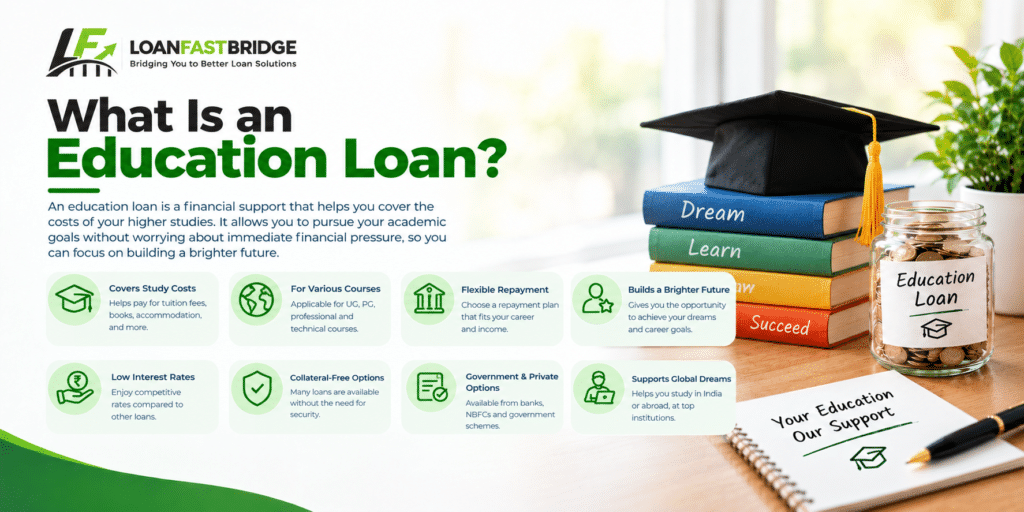
An Education Loan is a loan offered by banks, financial institutions, and other eligible lenders to help students finance higher education. The borrower is generally the student, while a parent, guardian, or another eligible family member may act as a co-applicant.
The loan amount depends on several factors, including the course, institution, location, total education expenses, applicant’s profile, co-applicant’s income, and the lender’s policies.
An Education Loan may be available for education in India as well as recognized institutions overseas. Different lenders have different requirements, interest rates, repayment periods, margin requirements, and collateral policies.
Before choosing a loan, students should carefully compare the total cost of borrowing rather than selecting an option solely because it offers a lower advertised interest rate.
Why Consider?
Education is an investment in your future, but paying the entire cost upfront can put considerable pressure on a family budget. An Education Loan allows eligible students to spread the cost of education over a longer repayment period.
One of the biggest advantages is that students may be able to pursue a course that would otherwise be difficult to afford immediately. Instead of liquidating long-term investments or using all available family savings, borrowers can use structured financing to meet education-related expenses.
An Education Loan can also help families maintain their emergency funds and financial reserves. However, borrowing should always be based on realistic repayment capacity and the expected career prospects after completing the course.
What Expenses Can an Education Loan Cover?
The expenses covered by depend on the lender, course, institution, and loan scheme. Common eligible expenses may include:
- Tuition and admission fees
- Examination and laboratory fees
- Hostel or accommodation charges
- Books and study materials
- Computer or other required equipment
- Uniforms and other academic requirements
- Travel expenses for eligible overseas courses
- Deposits and other institution-related charges
- Other approved expenses directly connected with education
Students should obtain a detailed fee structure from their educational institution before applying. This helps determine how much financing is actually required.
It is generally better to borrow only the amount needed rather than taking the maximum amount available. A larger loan means higher interest costs and potentially larger repayments in the future.
Who Can Apply?
Eligibility criteria vary between lenders, but an Loan is generally available to students who have secured admission to an eligible course or institution.
Typical eligibility requirements may include:
- The applicant should be an Indian citizen or meet the lender’s specified residency requirements.
- The student should have secured admission to a recognized educational institution.
- The selected course should fall within the lender’s approved categories.
- The student may need to meet academic requirements.
- A parent or guardian may be required as a co-applicant.
- The co-applicant generally needs to satisfy income and credit-related requirements.
- For larger loans, collateral or a suitable financial guarantee may be required depending on the lender’s policy.
Eligibility is not identical across banks and financial institutions. Therefore, applicants should verify the current requirements directly with the lender before submitting an application.
Studies in India
Students pursuing higher education in India may use for courses such as engineering, medicine, management, law, technology, pharmacy, architecture, postgraduate programs, and other recognized professional or academic courses.
The institution and course usually need to meet the lender’s eligibility criteria. Some lenders may maintain specific lists of approved institutions or courses.
When applying, students should have their admission letter, fee structure, academic records, and other required documents ready. A strong academic profile and a financially suitable co-applicant can help make the application process smoother, although approval ultimately depends on the lender’s assessment.
Education Loan for Studying Abroad
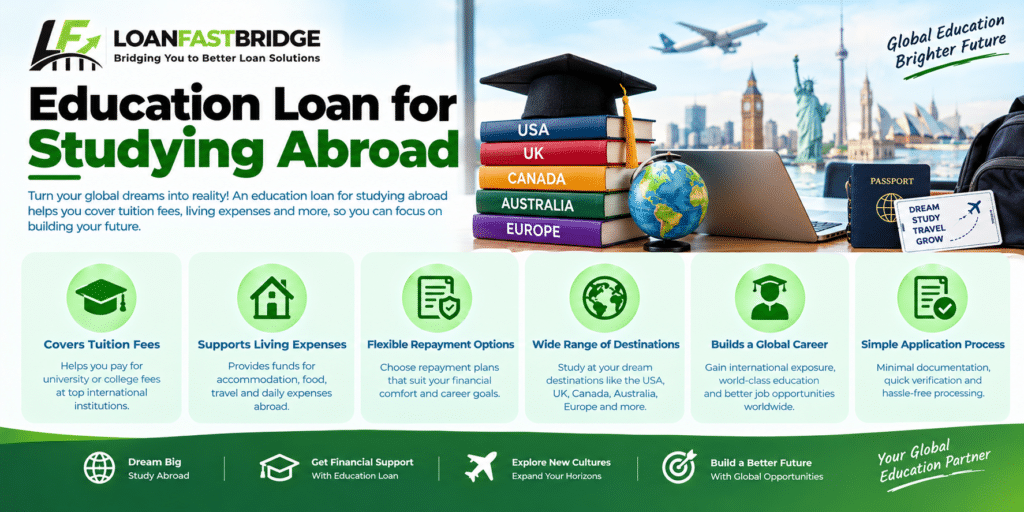
Studying abroad can involve significantly higher expenses because students may need to pay international tuition fees, accommodation costs, living expenses, insurance, travel costs, and other charges.
An Education Loan for overseas education can help eligible students manage these expenses without paying the entire cost from personal funds.
Before applying, students should prepare a realistic budget that includes tuition fees and living expenses for the entire study period. Currency fluctuations should also be considered when planning an overseas education budget.
Students should check whether the lender finances the particular country, university, course, and expense categories. They should also understand the requirements relating to collateral, co-applicant income, margin contribution, and repayment.
Documents Required
The exact documentation varies by lender, but applicants commonly need documents such as:
- Student’s identity and address proof
- Parent or guardian’s identity and address proof
- Passport-size photographs
- Academic certificates and mark sheets
- Admission or offer letter
- Course fee structure
- Entrance examination results, where applicable
- Proof of income of the co-applicant
- Bank statements
- Income tax documents, where required
- Employment-related documents for salaried applicants
- Business and financial documents for self-employed co-applicants
- Collateral documents, if applicable
For overseas education, additional documents such as a valid passport, visa-related documents, university correspondence, and foreign institution details may be requested.
Applicants should provide accurate and complete information. Missing or inconsistent documentation can delay processing.
Interest Rates
The interest rate is one of the most important factors when selecting an Education Loan. Interest rates can vary depending on the lender, loan amount, course, institution, repayment profile, collateral, and other factors.
Some loans may have floating interest rates, meaning the rate can change over time based on the applicable benchmark and lender’s terms. Others may be offered under different pricing structures.
Students should not compare loans based only on the headline interest rate. They should also examine:
- Processing fees
- Prepayment or foreclosure conditions
- Loan tenure
- Moratorium terms
- Margin requirements
- Collateral requirements
- Insurance requirements, if any
- Other applicable charges
Understanding the complete cost of borrowing provides a more accurate comparison between different options.
What Is the Moratorium Period?
One of the important features of an Education Loan can be the moratorium period. Depending on the lender and scheme, repayment may begin after the completion of the course and an additional specified period.
The exact terms differ between lenders. Students should understand whether interest continues to accrue during the study period and how that interest is treated when repayment begins.
A moratorium does not necessarily mean that interest stops accumulating. Therefore, borrowers should carefully read the loan agreement and repayment schedule before accepting the facility.
How Is an Education Loan Repaid?
Once the repayment period begins, the borrower generally repays the loan through scheduled instalments, often in the form of Equated Monthly Instalments (EMIs).
The EMI depends primarily on:
- Principal amount
- Interest rate
- Repayment tenure
A longer tenure can reduce the monthly EMI but may increase the total interest paid over the life of the loan. Conversely, a shorter tenure may result in higher monthly payments but potentially lower overall interest costs.
Students should choose a repayment structure that is realistic based on expected income after graduation. It is important not to assume that a high starting salary is guaranteed simply because a particular course has strong career prospects.
Benefits of Taking an Education Loan
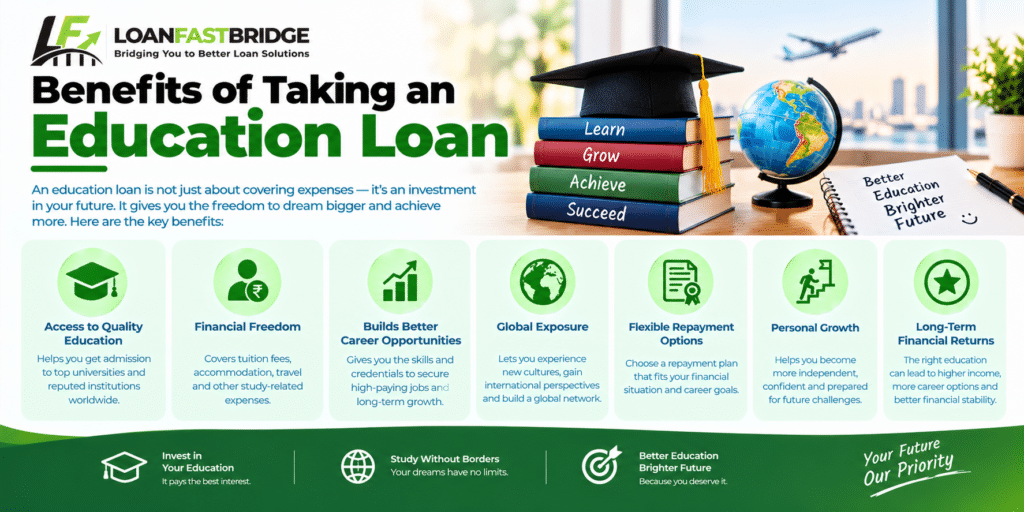
An Education Loan can provide several advantages when used responsibly.
1. Access to Quality Education
Students may be able to pursue courses or institutions that require substantial upfront investment.
2. Reduced Immediate Financial Pressure
Instead of paying the entire education cost from savings, families can distribute the financial burden over time.
3. Longer Repayment Period
Depending on the lender and loan scheme, borrowers may receive a repayment period that makes the monthly obligation more manageable.
4. Opportunity to Study Abroad
Eligible students can use education financing to meet some of the substantial costs associated with international education.
5. Potential Tax Benefits
Under applicable Indian tax laws, eligible borrowers may be able to claim deductions on interest paid on certain education loans, subject to prevailing conditions and eligibility requirements. Tax rules can change, so borrowers should verify the current provisions with a qualified tax professional or official government sources.
6. Preserving Family Savings
Instead of using all available savings for education, families may retain some funds for emergencies and other long-term financial needs.
Education Loan vs Personal Loan
Students sometimes consider a personal loan as an alternative to an Education Loan. However, the two products are designed for different purposes.
An education-focused loan may offer features specifically structured around academic expenses, such as a study-period moratorium and potentially longer repayment arrangements. A personal loan is generally an unsecured loan intended for broader personal financial requirements.
The appropriate option depends on the student’s circumstances, loan amount, lender terms, and total cost. Comparing interest rates, fees, repayment periods, and eligibility conditions is essential before making a decision.
Factors to Consider Before Taking an Education Loan
Borrowing money for education is a major financial decision. Before applying for an Education Loan, consider the following:
Course and Institution
Check the reputation, accreditation, placement record, curriculum, and career prospects of the institution and course.
Total Cost
Calculate tuition, accommodation, books, transportation, living expenses, and other expected costs.
Expected Income
Research realistic salary ranges and employment opportunities after completing the course. Avoid basing your repayment plan solely on optimistic assumptions.
Interest Rate
Understand whether the interest rate is fixed or floating and what factors could cause it to change.
Repayment Tenure
Compare different repayment periods and calculate how they affect both EMI and total interest.
Collateral
Some higher-value loans may require security. Understand what assets may be accepted and the consequences of default.
Co-Applicant Responsibility
A parent or guardian who becomes a co-applicant should understand their financial responsibility under the loan agreement.
How to Apply for an Education Loan
The application process generally involves the following steps:
Step 1: Select the Course and Institution
Obtain admission to an eligible course and institution.
Step 2: Calculate Your Funding Requirement
Prepare a detailed estimate of tuition fees and other eligible education expenses.
Step 3: Compare Lenders
Compare interest rates, fees, tenure, moratorium, collateral requirements, and other conditions.
Step 4: Prepare Documents
Keep academic, admission, identity, income, and financial documents ready.
Step 5: Submit the Application
Complete the lender’s online or offline application form and provide the requested documents.
Step 6: Verification
The lender may verify the student’s admission, academic background, co-applicant’s income, credit history, and other relevant information.
Step 7: Loan Sanction
If the application satisfies the lender’s requirements, the loan may be sanctioned subject to applicable terms and conditions.
Step 8: Disbursement
The approved amount is generally disbursed according to the lender’s policy and the educational institution’s fee schedule.
How to Improve Your Chances of Loan Approval
There is no guaranteed method for approval, but applicants can improve their application quality by maintaining accurate documentation and choosing an appropriate loan amount.
A financially stable co-applicant, consistent income documentation, a strong academic record, and admission to a recognized institution can support the application.
Applicants should also review their credit history where relevant. Existing unpaid debts or repayment issues involving the co-applicant can affect the lender’s assessment.
Most importantly, the requested loan amount should be reasonable compared with the actual education expenses and the applicant’s financial circumstances.
Common Mistakes to Avoid
Taking an Education Loan without understanding the complete repayment obligation can create financial stress later. Some common mistakes include:
- Borrowing more than necessary
- Choosing a lender only because of a low advertised rate
- Ignoring processing and other fees
- Not checking whether the course qualifies
- Failing to understand the moratorium period
- Ignoring interest accumulation during the study period
- Choosing an unrealistic repayment tenure
- Not maintaining proper loan documents
- Assuming employment or salary is guaranteed after graduation
A careful financial assessment before borrowing can prevent many of these problems.
Is an Education Loan a Good Option?
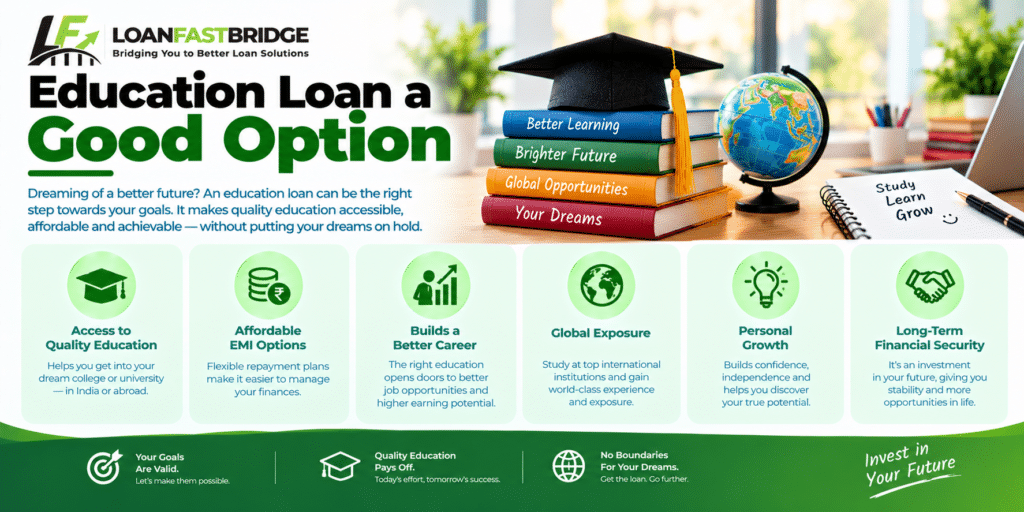
An Education Loan can be a useful financial tool when the course has credible career prospects and the expected future income can reasonably support repayment.
However, it should not be treated as free money. The amount borrowed eventually has to be repaid, along with applicable interest and charges.
Students should consider scholarships, grants, family contributions, institutional assistance, and other legitimate funding options alongside an Education Loan. Combining different funding sources may reduce the total amount that needs to be borrowed.
The best borrowing decision is one that supports education without creating an unnecessarily heavy financial burden after graduation.
Frequently Asked Questions About Education Loans
Can students apply for an this Loan without a job?
Yes. Students are generally the primary beneficiaries of education financing, while a parent or guardian may act as a co-applicant. The exact eligibility requirements depend on the lender.
Can cover living expenses?
Some loan schemes may cover specified living or accommodation expenses, particularly for eligible overseas education. The exact expenses and limits depend on the lender and loan agreement.
Is collateral always required?
No. Collateral requirements vary depending on the loan amount, lender, course, institution, and applicable scheme. Applicants should check the current requirements before applying.
Can an Education Loan be used for overseas studies?
Yes, eligible lenders may offer financing for recognized overseas courses and institutions. The country, university, course, and expenses must satisfy the lender’s requirements.
When does repayment usually begin?
Repayment typically begins according to the terms specified in the loan agreement and may follow a moratorium linked to the study period and an additional period. Exact terms vary by lender.
Can be prepaid?
Many lenders allow borrowers to make partial or full prepayments, subject to their applicable terms and conditions. Borrowers should check the relevant agreement for any charges or restrictions.
Final Thoughts
Higher education can be one of the most important investments a student makes in their future. When planned carefully, an Education Loan can make quality education more accessible while allowing families to manage their finances over a longer period.
However, borrowing should always be based on a realistic assessment of course costs, career prospects, expected income, interest rates, repayment terms, and overall financial capacity.
Before choosing an Education Loan, compare multiple lenders, read the terms carefully, understand the complete cost of borrowing, and calculate the expected repayment obligation. Students should also explore scholarships and other financial-aid opportunities to reduce their dependence on debt.
Ultimately, the goal should not simply be to obtain the largest possible loan. The goal is to secure the right amount of financing for a valuable education while keeping future repayment manageable. With proper research and responsible planning, an Education Loan can help students pursue their academic ambitions without placing unnecessary pressure on their families’ finances.