
Managing everyday expenses, purchasing essential products, or handling an unexpected financial requirement can sometimes put pressure on your monthly budget. Whether you want to buy a new refrigerator, upgrade your home appliances, purchase a smartphone, or pay for an important personal expense, a consumer loan can help you spread the cost over a period instead of paying the entire amount upfront.
However, borrowing money is a financial commitment that requires careful planning. Before choosing a loan, it is important to understand how it works, what it costs, which documents are required, and whether the monthly repayments fit comfortably within your budget.
This comprehensive guide explains consumer financing in simple terms, helping individuals and families understand their options and make informed financial decisions. It also explores the importance of comparing lenders, checking repayment conditions, and choosing borrowing options that suit your financial circumstances.
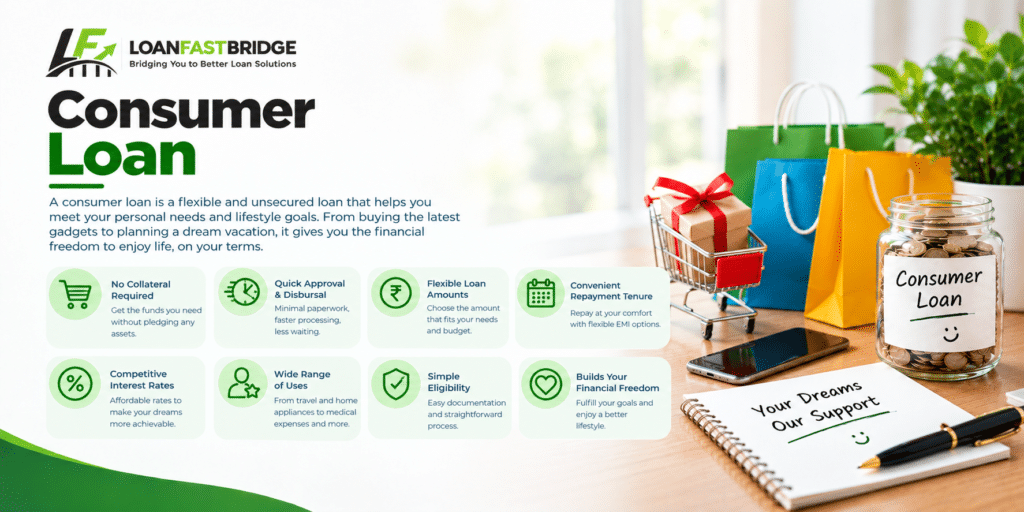
What Is a Consumer Loan?
A consumer loan is a type of credit used by individuals to purchase goods or pay for personal expenses rather than finance business operations. Depending on the lender and product, it may be offered as a personal loan, consumer durable loan, or another form of individual financing.
These Consumer loans can help people manage planned purchases and certain unexpected expenses without using all their available savings at once.
For example, suppose you need to purchase a washing machine worth ₹35,000. Instead of paying the entire amount immediately, you may be eligible to finance the purchase through a lender or a retailer’s financing partner. You then repay the borrowed amount through scheduled instalments according to the agreement.
Consumer financing is available through banks, non-banking financial companies (NBFCs), and eligible financing partners. The amount, interest rate, repayment period, and approval requirements depend on the specific product and lender.
It is important to remember that not every consumer loan works in the same way. Some facilities are linked to a specific purchase, while others allow borrowers to use the approved funds for a wider range of eligible personal expenses.
Why Do People Choose Consumer Financing?
Consumer financing can make certain purchases more manageable by distributing their cost over time. Instead of waiting until enough savings have accumulated, an eligible borrower may be able to obtain a product or meet an expense sooner.
Common reasons for using consumer credit include:
- Purchasing household appliances and electronics.
- Buying furniture and essential home equipment.
- Managing eligible personal expenses.
- Replacing an essential product that has stopped working.
- Covering certain unexpected expenses.
- Spreading the cost of a planned purchase across several months.
For example, a family whose refrigerator has stopped working may need a replacement immediately. Financing could help them purchase a suitable appliance without using all their emergency savings.
Nevertheless, borrowing is not always the most economical choice. If a purchase is not urgent, saving in advance may help avoid interest and other charges. The decision should depend on the urgency of the expense, the total borrowing cost, and the borrower’s repayment capacity.
Types of Consumer Loans Available in India
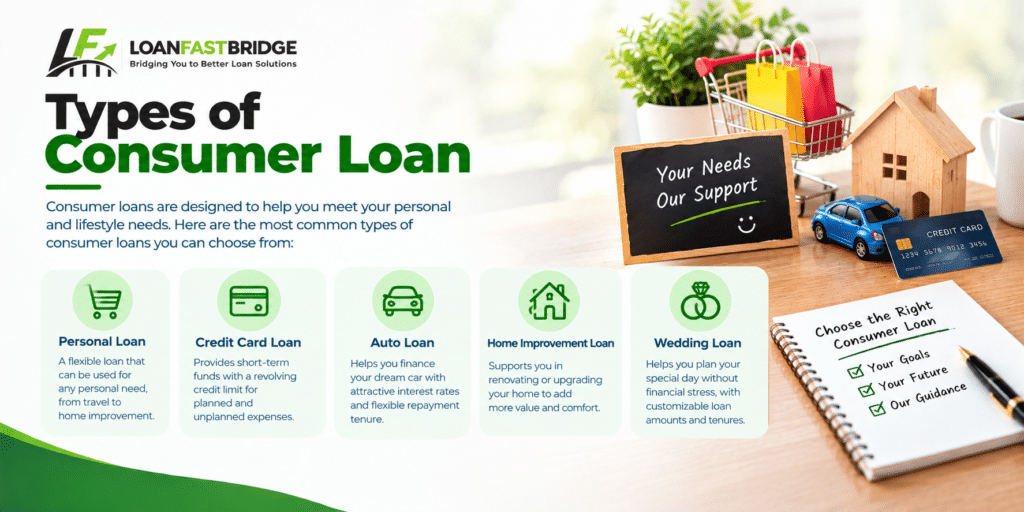
Different Consumer financing products serve different needs. Understanding the distinctions can help you select an appropriate option.
1. Consumer Durable Loans
Consumer durable loans are generally used to finance products such as televisions, refrigerators, washing machines, air conditioners, laptops, and other eligible electronics or household appliances.
These loans are frequently offered at retail stores or through online checkout platforms in partnership with financial institutions.
Depending on the offer, borrowers may receive a fixed repayment schedule or an instalment-based payment option. Some offers are advertised as no-cost EMI, but customers should examine the complete price, processing fees, taxes, and other conditions before accepting them.
This type of financing is suitable for eligible purchases where the borrower wants to spread the cost over an agreed period.
2. Personal Loans
A personal loan is generally an unsecured borrowing option that can be used for various eligible personal expenses. Unlike purchase-specific financing, the borrower may not need to identify a particular product being purchased.
Depending on the lender’s terms, the money may be used for expenses such as home repairs, travel, family functions, or certain emergencies.
Approval usually depends on factors such as income, employment, credit history, existing liabilities, and the lender’s eligibility requirements.
Because personal loans can carry relatively high interest rates compared with some secured borrowing products, applicants should compare offers carefully before making a decision.
3. Short-Term Consumer Financing
Some lenders offer shorter repayment plans for eligible purchases or specific expenses. These facilities may have smaller approved amounts and shorter repayment periods than conventional personal loans.
Although shorter repayment periods can reduce the time spent in debt, they may also result in higher monthly instalments.
Borrowers should confirm the payment schedule, applicable fees, late-payment charges, and consequences of missing an instalment.
4. Credit Card Instalment Plans
Certain credit card purchases can be converted into equated monthly instalments, subject to the card issuer’s conditions.
This option may be convenient when an eligible purchase has already been made. However, conversion charges, interest, taxes, and changes to available credit limits may apply.
Consumers should check the total cost of the instalment plan rather than assuming that every conversion offer is inexpensive.
How Does a Consumer Loan Work?
The process is generally straightforward, although the exact steps depend on the lender and product.
Step 1: Identify your requirement. Decide what you need to purchase or which eligible expense you need to cover.
Step 2: Calculate the amount required. Consider the purchase price, any upfront payment, and other expenses.
Step 3: Compare available financing options. Review interest rates, processing fees, repayment periods, and other conditions.
Step 4: Submit an application. Provide the required personal, employment, income, and identity information.
Step 5: Complete the verification process. The lender may evaluate your income, credit history, existing financial obligations, and repayment capacity.
Step 6: Review the offer. If approved, check the sanctioned amount, interest rate, instalment amount, fees, and repayment schedule.
Step 7: Receive the funds or purchase. Depending on the arrangement, the lender may transfer money to your account or pay the eligible merchant directly.
Step 8: Repay according to the agreement. Make each instalment on time and monitor your outstanding balance.
Before accepting any offer, read the loan agreement carefully. The terms in the agreement should take priority over general advertisements or verbal assurances.
Who Is Eligible to Apply?
Consumer Eligibility requirements vary across lenders and financing products. However, applicants are commonly assessed using several financial and personal factors.
Age
Lenders usually specify minimum and maximum age limits. Applicants must meet the relevant requirements when applying and, where applicable, throughout the repayment period.
Income
A stable and sufficient income can help demonstrate the ability to repay borrowed money. Depending on the product, lenders may accept salaried applicants, self-employed individuals, or both.
Employment or Business Stability
Employment history, business continuity, and regular earnings may influence the lender’s assessment of repayment capacity.
Credit History
Credit reports can provide information about existing loans, repayment behaviour, credit card balances, and previous defaults. A positive repayment history may improve the likelihood of approval, although it does not guarantee it.
Existing Financial Obligations
Lenders may assess how much of your income is already committed to rent, loan instalments, credit cards, and other expenses.
Identity and Address Verification
Applicants generally need to provide valid documentation to establish their identity and address.
Meeting basic eligibility criteria does not guarantee approval. Each lender applies its own underwriting policies and may consider additional information before making a decision.
Documents Required for a Consumer Loan
The documentation depends on the lender, loan amount, employment status, and type of financing.
Commonly requested documents may include:
- PAN or another accepted identity document.
- Aadhaar or other accepted address documentation, where applicable.
- Recent salary slips for salaried applicants.
- Bank statements.
- Employment details.
- Income-tax returns or financial statements for self-employed applicants, where required.
- Photographs or digital identity verification.
- Purchase invoice or product details for purchase-specific financing.
Some digital applications may require fewer documents because certain information can be verified electronically, subject to the applicable rules and the lender’s process.
Applicants should provide accurate information and use official lender websites, authorised applications, or verified retail financing channels. Never share an OTP, PIN, or banking password with someone claiming to guarantee loan approval.
Understanding Interest Rates and Other Charges
Interest is the cost of borrowing money. It can vary according to the lender, product, loan amount, repayment period, credit profile, and prevailing financial conditions.
However, the interest rate alone does not reveal the complete cost of financing.
Before accepting an offer, review the following charges and conditions:
Interest rate: Determine whether the rate is fixed or variable and how interest is calculated.
Processing fee: Some lenders charge an upfront fee for processing the application.
Documentation charges: Additional charges may apply depending on the lender and product.
Late-payment charges: Missing instalments can result in penalties or other consequences under the agreement.
Prepayment or foreclosure charges: Check whether closing the loan early involves a fee.
Taxes: Applicable taxes may be charged on certain fees and services.
Annual Percentage Rate (APR): Where disclosed, this can help you understand the overall annualised cost of borrowing, including relevant charges.
When comparing two offers, evaluate the total amount payable across the full repayment period. A lower advertised rate does not necessarily mean a cheaper loan if the associated fees are substantially higher.
What Is a No-Cost EMI Offer?
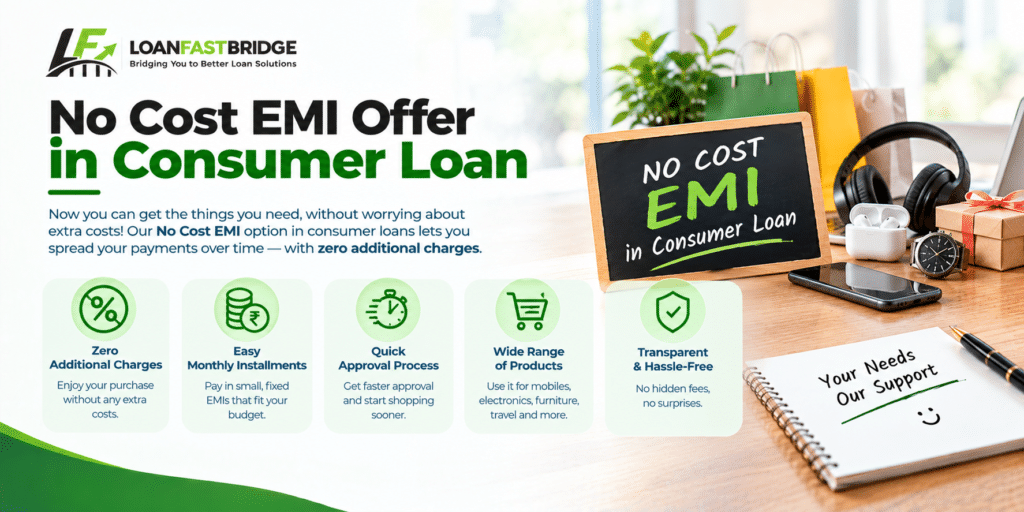
No-cost EMI offers are commonly used to promote electronics, appliances, and other retail products.
These offers are generally structured so that the consumer’s instalments do not include an explicitly charged interest amount under the advertised arrangement. However, the actual economics of the offer can depend on the retailer’s discount, the financing structure, applicable processing fees, and other conditions.
For example, a product may be offered at a particular price with an instalment plan, while a separate cash purchase may qualify for a discount. Comparing both prices can help you determine which option provides better value.
Before choosing a no-cost EMI offer, ask:
- Is there a processing fee?
- Is the advertised price different from the cash price?
- Are taxes applicable to any financing charges?
- Is the offer conditional on using a specific card or lender?
- What happens if an instalment is missed?
- Are there any cancellation or early-closure conditions?
Read the offer terms rather than relying exclusively on the phrase “no cost.”
How Much Should You Borrow?
The appropriate borrowing amount depends on your needs and financial circumstances. An approved limit should not automatically become your target amount.
Start by calculating your monthly income after taxes and subtracting essential expenses, savings contributions, and existing debt payments.
The remaining amount can help you estimate how much room you have for another instalment.
For example, consider an individual earning ₹45,000 per month after taxes. If essential household expenses, existing repayments, and planned savings already consume most of that income, taking on another monthly payment may create unnecessary pressure.
By contrast, someone with a similar income but fewer obligations may have more room for a manageable instalment.
These examples are illustrative. There is no single repayment-to-income ratio that is suitable for every borrower. The important question is whether you can meet the payments comfortably even if an unexpected expense arises.
How to Calculate Your Monthly EMI
An equated monthly instalment, commonly called an EMI, is the scheduled payment made towards a loan. For a standard amortising loan, it generally includes both principal and interest.
The EMI depends on three major factors:
- The amount borrowed.
- The applicable interest rate.
- The repayment tenure.
Consider a hypothetical loan of ₹1,00,000 at an annual interest rate of 12%, repaid over 12 months. Assuming a standard monthly reducing-balance calculation, the EMI would be approximately ₹8,885.
The total of the 12 instalments would be approximately ₹1,06,620, before any additional fees or charges.
This is only an illustration. Actual payments can differ depending on the lender’s calculation method, dates, fees, and contractual terms.
A longer tenure generally lowers the monthly payment but can increase the total interest paid. A shorter tenure generally raises the monthly payment but may reduce the total interest cost.
Use the lender’s repayment schedule to confirm the actual figures before accepting an offer.
Benefits of Consumer Financing
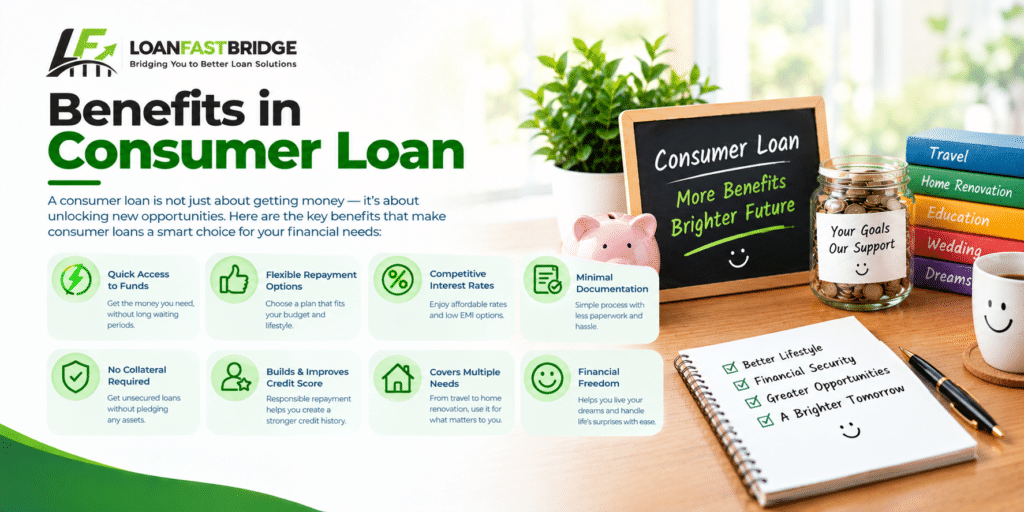
When used responsibly, consumer financing can provide several practical advantages.
Better Cash-Flow Management
Spreading a purchase over instalments can help preserve cash for rent, household expenses, and emergencies.
Access to Essential Products
Financing can make certain urgent purchases possible when paying the full price immediately would be difficult.
Predictable Repayments
Fixed instalments can make monthly budgeting easier when the loan terms specify a consistent payment schedule.
Potential to Build a Credit History
Responsible repayment of a credit product reported to credit bureaus may contribute to establishing or maintaining a credit history. The impact depends on the lender’s reporting practices and the borrower’s overall credit profile.
Flexible Financing Options
Different products may provide different repayment periods and approval requirements, allowing consumers to compare options suited to their needs.
These benefits depend on affordability and transparent loan terms. Borrowing for unnecessary purchases or taking multiple loans simultaneously can undermine the advantages.
Risks and Mistakes to Avoid
A convenient application process should not replace careful financial evaluation.
Borrowing for Non-Essential Purchases
Financing luxury items or discretionary purchases can create long-term obligations for products that may lose value quickly.
Ignoring the Total Repayment
A small monthly instalment may appear affordable, but the full repayment amount could be significantly higher than the original purchase price.
Missing Instalments
Late payments may lead to additional charges, collection activity, and negative credit reporting, depending on the agreement and reporting practices.
Applying to Multiple Lenders Without a Plan
Frequent applications can lead to multiple credit enquiries, depending on the lender and bureau process. Compare eligibility and costs before submitting applications.
Falling for Fraudulent Offers
Avoid agents or websites promising guaranteed approval in exchange for suspicious advance payments. Verify the lender’s identity and regulatory status before sharing personal information.
Overlooking Existing Debt
Multiple instalments can accumulate quickly. Consider your total monthly debt commitments rather than assessing each loan independently.
Accepting Unclear Terms
If the lender cannot clearly explain the interest rate, charges, payment dates, and consequences of default, do not rush into the agreement.
Consumer Loan vs Education Loan: What Is the Difference?
Although both involve borrowing money, their purposes and conditions can differ considerably.
A consumer loan is generally intended for personal spending or eligible purchases, including appliances and other consumer goods.
An education loan is designed to finance eligible education-related expenses, such as tuition fees and certain academic or living costs, depending on the lender’s terms.
Education financing may offer repayment arrangements linked to the student’s course duration and a specified moratorium. Some eligible borrowers may also qualify for government assistance under applicable schemes.
Consumer financing usually follows the repayment structure specified for the particular product and may have a shorter repayment period.
The correct option depends on the purpose of borrowing. Applicants should choose a product designed for their actual requirement rather than using a financing facility without checking its permitted uses.
Tips for Choosing the Right Lender
Choosing a lender requires more than comparing promotional offers.
First, verify that the financial institution is legitimate and authorised to provide the relevant credit product.
Second, compare the total repayment amount across at least two or three suitable offers, where practical.
Third, review the lender’s interest rate, fees, repayment tenure, prepayment rules, and late-payment conditions.
Fourth, ensure that the repayment schedule fits your budget after accounting for essential expenses and savings.
Fifth, read the sanction letter and loan agreement. Ask for clarification about any unclear condition before signing.
Finally, retain copies of the agreement, payment receipts, and relevant communications. These records can be useful if you need to resolve a billing issue or verify the outstanding balance.
Frequently Asked Questions
Can I apply without a high salary?
Possibly. Approval depends on the lender’s minimum income requirements, employment profile, existing liabilities, credit history, and the amount requested. A high salary is not the only factor considered.
Can I get a consumer loan with a low credit score?
Some lenders may consider applicants with limited or weaker credit histories, but approval is not guaranteed. The available amount, interest rate, or other conditions may be less favourable.
Can I repay my loan early?
Many products permit prepayment or early closure, but the applicable terms and charges depend on the agreement and relevant regulations. Confirm the conditions with the lender before making additional payments.
Does applying affect my credit score?
A formal credit application may result in a credit enquiry, depending on the lender’s process. The effect varies, so avoid submitting unnecessary applications.
Is consumer financing better than using savings?
Not necessarily. Using savings can avoid borrowing costs, while financing can preserve cash for other needs. Compare the urgency of the purchase, the total cost, and your emergency reserves before deciding.
Can self-employed individuals apply?
Yes, some lenders accept self-employed applicants. They may request business records, bank statements, income-tax returns, or other evidence of financial stability.
Conclusion
Consumer financing can be useful for managing essential purchases and eligible personal expenses, provided the borrower understands the costs and repayment obligations.
Before applying, identify the actual amount required, review your monthly budget, compare lenders, and examine the interest rate, fees, tenure, and total repayment amount. Check the agreement carefully and avoid borrowing more than you can comfortably repay.
For individuals planning other major financial commitments, it is equally important to select the right product for the intended purpose. Whether you are financing a household appliance or considering an education-related expense, the terms should match your needs and financial circumstances.
At LoanFastBridge, informed financial decisions begin with understanding your options. Compare available products carefully, verify the lender’s terms, and choose a repayment plan that supports your financial stability rather than placing unnecessary pressure on your monthly budget.
A well-informed borrowing decision is not simply about getting approved. It is about choosing financing you can manage responsibly from the first instalment to the last.