
Buying a house is one of the biggest financial decisions most people make. For many buyers, arranging the required funds is an important part of the process. A home loan can help make property ownership more achievable by allowing eligible borrowers to finance a significant portion of the purchase cost and repay the amount over an agreed period.
However, choosing a suitable loan is about much more than finding a low interest rate. The loan amount, tenure, EMI, processing charges, eligibility requirements, documentation, repayment conditions and your overall financial position all need to be considered before making a decision.
At LoanFastBridge, the aim is to make the borrowing journey easier to understand. Professional guidance can help you compare relevant options, prepare documentation and understand the process before you commit to a long-term financial obligation.
This guide explains the key things you should know before applying for housing finance.
What Is a Home Loan?

A home loan is a form of financing provided by an eligible lender to help a borrower purchase, construct or, depending on the lender’s product, undertake other eligible housing-related purposes.
The borrower generally repays the principal amount along with applicable interest through scheduled instalments over a predetermined tenure.
The property may also serve as security for the loan, depending on the product and lender’s terms.
A typical borrowing journey can involve:
Requirement assessment → Eligibility evaluation → Property selection → Application → Documentation → Lender assessment → Sanction → Property and legal checks → Disbursement → Repayment
The exact process can vary according to the lender, property, applicant profile and type of transaction.
Before signing a loan agreement, it is important to understand the complete terms rather than relying only on an advertised interest rate or estimated EMI.
Why Do People Choose Home Loan?
Purchasing a property requires substantial capital. Many buyers may have enough savings for a down payment but may not want to use their entire available savings for the purchase.
Housing finance can provide a structured way to fund the remaining eligible amount while retaining some liquidity for other financial needs.
Some common reasons people consider this form of financing include:
- Purchasing a first home
- Buying a larger property
- Purchasing a residential property for a family
- Constructing a house
- Financing an eligible residential property
- Moving from rented accommodation to home ownership
The right decision depends on the borrower’s income, savings, existing obligations, financial goals and ability to make repayments comfortably.
Borrowing should be approached as a long-term financial commitment rather than simply a way to access a larger amount of money.
Types of Home Loans

Not every housing-related loan serves the same purpose. Understanding the broad categories can help you identify which option may be relevant to your situation.
1. Home Purchase Loan
This is commonly used to finance the purchase of a residential property.
The property may be newly constructed, under construction or previously owned, depending on the lender’s eligibility criteria.
Before applying, buyers should evaluate the property’s legal status, ownership documents, approved plans and other requirements relevant to the lender’s assessment.
2. Home Construction Loan
People who own an eligible plot and want to construct a house may explore construction financing.
The release of funds can be linked to construction stages, depending on the lender’s policies.
Applicants should therefore understand how disbursement works and what documentation or inspections may be required at different stages.
3. Home Improvement or Renovation Finance
Some lenders offer products designed for eligible repairs, improvements or renovation work.
The permitted purpose, loan amount and documentation can differ between lenders.
It is important to understand whether the planned work qualifies before making financial commitments.
4. Balance Transfer of Home Loan
A borrower who already has housing finance may explore transferring the outstanding loan to another lender if the new arrangement provides suitable terms.
However, a transfer should not be based solely on a lower advertised rate.
Consider the complete financial impact, including applicable charges, remaining tenure, outstanding principal and the total interest payable under both arrangements.
How Does a Home Loan Work?
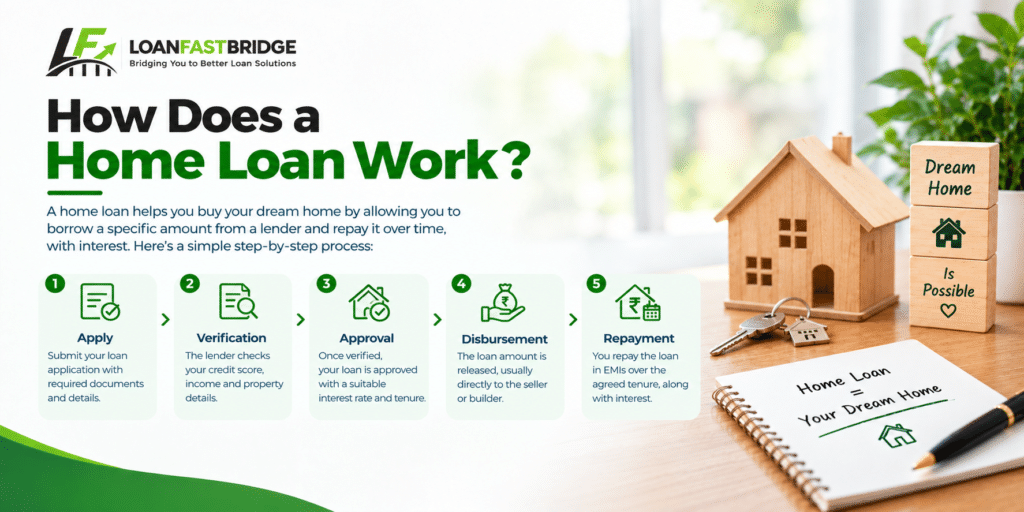
Understanding the basic structure makes it easier to evaluate an offer home loan.
Suppose a property costs ₹60 lakh and the buyer contributes part of the purchase price from their own funds. The remaining eligible amount may potentially be financed through a lender.
The lender evaluates the applicant and property before deciding whether to approve the requested amount.
Once approved, the borrower repays the outstanding amount through EMIs or another agreed repayment structure.
An EMI generally consists of a principal component and an interest component. The proportion of each can change during the repayment period.
This is why borrowers should look beyond the monthly instalment and understand the total amount payable over the entire tenure home loan.
What Is Home Loan an EMI?
EMI stands for Equated Monthly Instalment.
It is the scheduled amount a borrower generally pays each month toward the loan under the agreed repayment structure.
The EMI is influenced by factors such as:
- Borrowed amount
- Interest rate
- Loan tenure
- Repayment structure
A longer tenure can make the monthly instalment more manageable, but it can also result in a higher overall interest outgo.
A shorter tenure can increase the monthly repayment while potentially reducing the total interest paid.
Therefore, the objective should not simply be to find the lowest EMI. The objective should be to find a repayment structure that balances monthly affordability with the overall cost of borrowing.
Factors That Affect Home Loan Eligibility
Lenders assess applicants using their own eligibility policies. While criteria differ, several factors can influence the assessment.
Income
Stable and sufficient income can be an important consideration because it indicates the borrower’s capacity to make regular repayments.
Both salaried and self-employed applicants may be eligible for housing finance, although documentation and assessment methods can differ.
Credit History
Your credit history provides lenders with information about previous borrowing and repayment behaviour.
A strong repayment record can support your overall financial profile, while missed or delayed payments may affect how lenders evaluate your application.
Before applying, review your credit information and make sure any inaccuracies are addressed through the appropriate channels.
Existing Obligations
Existing EMIs, credit card balances and other financial commitments can influence repayment capacity.
Someone earning a substantial income may still have limited borrowing capacity if a significant portion of that income is already committed to existing debt.
Age and Tenure
Age can affect the maximum permissible tenure offered by a lender.
A longer tenure may reduce the monthly repayment but extends the period for which the borrower remains financially committed.
Property Details
The property itself may be evaluated by the lender.
Legal documentation, ownership, valuation, location, approvals and other property-specific factors can influence the lending decision.
Documents Required for Home Loan
Home loan Documentation varies according to the lender, loan type and applicant profile. However, applicants may commonly be asked for documents relating to identity, address, income and financial records.
Depending on the circumstances, these can include:
- Identity proof
- Address proof
- PAN or applicable tax identification details
- Salary slips for salaried applicants
- Bank statements
- Income-tax or financial records where applicable
- Employment or business details
- Property-related documents
- Photographs
- Existing loan information
Self-employed applicants may need additional business and financial documents.
Providing accurate and complete information is important. Incomplete or inconsistent documentation can create unnecessary delays during the assessment process.
A consultancy can help applicants understand what documents may be required and organize them before submission.
How to Choose the Right Lender on Home Loan
There is no single lender that is automatically the best choice for every borrower.
Your financial profile, property, income, desired amount and repayment preferences all matter.
When comparing lenders, consider the following.
Interest Rate on home loan
The interest rate directly affects borrowing costs, but it should not be considered in isolation.
Understand whether the quoted rate is fixed, floating or linked to another structure specified in the lender’s terms.
Processing Charges on home loan
Check the processing fee and any other applicable charges before proceeding.
Ask for a clear explanation of all significant costs.
Loan Tenure on home loan
Compare different tenure options and calculate how each one affects both your EMI and overall repayment.
Home loan Prepayment Conditions
If you expect to make additional payments in the future, understand the lender’s applicable rules and charges.
Service and Communication
A loan can continue for many years. Reliable communication and accessible support can therefore be valuable throughout the borrowing relationship.
Home loan Documentation Requirements
Different lenders may have different requirements. Understanding these in advance can make the application process smoother.
Why Professional Loan Consultancy Can Help with Home Loan
Applying for housing finance independently is possible, but the process can become complicated when you are comparing several lenders, preparing documents and trying to understand financial terminology.
A professional loan consultancy can provide guidance throughout the process.
A consultant may help you:
Understand Your Requirement
The first step should be identifying how much you actually need and what you can reasonably afford to repay.
Compare Relevant Options
Rather than focusing only on one lender, you can evaluate potentially suitable alternatives according to your profile.
Understand Documentation
Professional guidance can help you identify missing or inconsistent documents before submission.
Navigate the Application Process
From initial application to subsequent stages, a consultant can help explain what is happening and what may be required next.
Understand Loan Terms
Important details such as tenure, interest structure, fees and repayment conditions should be understood before accepting an offer.
The final lending decision remains with the lender, and applicants should always review the official sanction and loan documents carefully.
How to Calculate an Affordable Loan Amount
One of the most important questions is not:
“How much can I borrow?”
It is:
“How much can I comfortably repay?”
Consider your monthly income and subtract regular expenses and existing financial commitments.
Then consider future costs such as:
- Children’s education
- Insurance
- Emergency savings
- Medical expenses
- Retirement planning
- Household expenses
- Property maintenance
- Lifestyle costs
A property purchase should not leave your finances excessively stretched.
It is generally better to maintain a reasonable financial cushion than to borrow the maximum amount available simply because you qualify for it.
Down Payment and Additional Costs
The purchase price of a property is not always the only expense involved.
Buyers may also need to account for costs such as:
- Registration-related expenses
- Stamp duty where applicable
- Legal or documentation expenses
- Property-related charges
- Insurance
- Brokerage, where applicable
- Moving expenses
- Renovation or furnishing costs
The exact costs vary by location, transaction and circumstances.
Before finalizing a property, prepare a realistic budget that includes these expenses.
Using every available rupee for the down payment without maintaining an emergency reserve can create financial pressure later.
Fixed vs Floating Interest Rates
Borrowers may encounter different interest-rate structures.
A fixed-rate structure generally provides greater predictability for the applicable period, while a floating-rate structure can change according to the terms of the loan and relevant benchmark or lending framework.
Neither option is universally better.
Your choice should depend on:
- Your financial stability
- Expected future income
- Risk tolerance
- Loan tenure
- Lender terms
- Overall financial plan
Always ask the lender how changes in the applicable rate could affect your EMI or repayment period home loan.
Common Mistakes to Avoid
Choosing Only the Lowest Rate
The lowest advertised rate does not automatically mean the lowest overall cost.
Review processing fees, conditions, tenure and other applicable charges.
Borrowing the Maximum Amount
Maximum eligibility is not the same as comfortable affordability.
Keep your long-term financial goals in mind.
Ignoring the Total Repayment
A low monthly EMI can appear attractive, but a long tenure may increase the total interest paid.
Not Reading the Agreement
Never sign a financial agreement without understanding its important terms.
If something is unclear, ask for an explanation before proceeding.
Providing Incorrect Information
Income, employment, financial and property information should be accurate.
Incorrect information can create problems during verification and assessment.
Focusing Only on Approval
Getting approved is only one part of the process.
The loan should also be appropriate for your financial situation.
How to Improve Your Home Loan Application
There are several practical steps borrowers can take before submitting an application.
Review Your Credit Profile
Check your credit report and identify any outstanding issues or inaccuracies.
Reduce Unnecessary Debt
If possible, reducing existing high-cost debt can improve your overall financial position.
Maintain Consistent Financial Records
Keep bank accounts and financial documents organized.
Prepare Documentation Early
Collect the required documents before starting the application rather than waiting for each request.
Choose a Realistic Property Budget
Your property budget should reflect your income, savings and repayment capacity.
Maintain an Emergency Fund
Avoid putting all available savings into the property transaction.
An emergency reserve can provide valuable financial protection when unexpected expenses arise.
Home Loan Process: Step by Step
Understanding the process can reduce uncertainty.
Step 1: Assess Your Requirement
Determine your approximate property budget, down payment and financing requirement.
Step 2: Check Eligibility
Review your income, credit profile, existing obligations and other relevant factors.
Step 3: Compare Lenders
Look at interest rates, fees, tenure options, eligibility and service.
Step 4: Prepare Documents
Collect identity, income, banking and property documents applicable to your situation.
Step 5: Submit the Application
Provide accurate information and the requested documentation.
Step 6: Lender Assessment
The lender evaluates your financial profile and the property according to its internal policies.
Step 7: Sanction
If approved, the lender issues the applicable sanction documentation outlining key terms.
Step 8: Complete Formalities
The borrower completes the required legal, documentation and property-related formalities.
Step 9: Disbursement
Funds are released according to the lender’s applicable process and conditions.
Step 10: Repayment
The borrower begins scheduled repayments according to the agreed terms.
Why Choose LoanFastBridge?
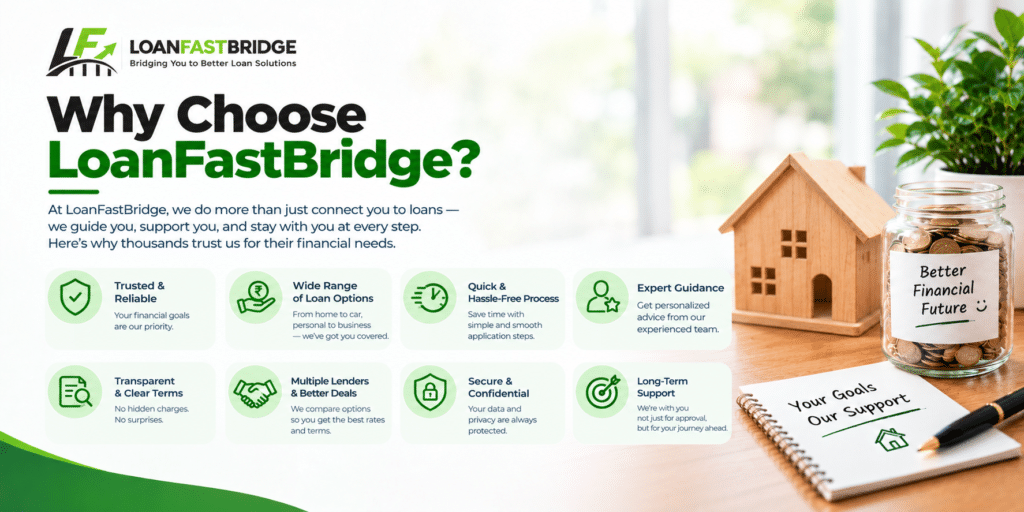
Choosing Home loan can feel complicated when you are dealing with property decisions, financial calculations, paperwork and lender requirements at the same time.
LoanFastBridge aims to simplify this journey through structured guidance and support.
The focus is on helping customers understand their requirements, explore suitable options and navigate the application process with greater clarity.
LoanFastBridge can assist customers exploring:
- Home loans
- Personal loans
- Car loans
- Loans against property
The objective is not simply to help customers apply for financing. It is to make the process more understandable so borrowers can evaluate their options more confidently.
Every borrower’s circumstances are different, and final approval, interest rates, loan amounts and other terms are determined by the respective lender based on applicable criteria.
Questions to Ask Before Taking a Home Loan
Before accepting an offer, ask these important questions:
What interest rate will apply to Home loan?
Understand the rate type and how it may change.
What will my monthly EMI be?
Ensure it fits comfortably within your budget.
What is the total amount payable?
Look beyond the monthly instalment.
What processing fees apply?
Ask about all significant charges.
What is the maximum and minimum tenure available?
Compare the effect of different repayment periods.
Are there prepayment conditions?
Understand the applicable rules before planning future additional payments.
What happens if I miss an EMI?
Ask about applicable charges and consequences.
Which documents are required?
Preparing them in advance can help reduce delays.
What property documents need to be verified?
Understand the lender’s property-related requirements before making commitments.
Frequently Asked Questions
Is a home loan suitable for everyone?
Not necessarily. It is a long-term financial commitment, so borrowers should evaluate their income, expenses, savings, existing obligations and future financial plans before proceeding.
How much home loan can I borrow?
The amount depends on factors such as income, credit profile, repayment capacity, property value and the lender’s policies.
Can self-employed people apply?
Yes, self-employed individuals may be eligible, subject to the lender’s criteria and documentation requirements.
Does a higher income guarantee approval?
No. Income is only one part of the lender’s assessment. Credit history, existing obligations, property details, documentation and other criteria can also matter.
Should I choose a longer tenure?
A longer tenure can reduce the monthly EMI but may increase the overall interest paid. Compare both monthly affordability and total repayment before deciding.
Can I apply with a co-applicant?
Depending on the lender’s rules, a co-applicant may be permitted and can sometimes affect the overall eligibility assessment. The exact conditions should be confirmed with the lender.
What if my application is rejected?
A rejection does not necessarily mean you can never obtain financing. First understand the reason, review your financial position and address relevant issues before considering another application.
Is the lowest interest rate always the best option?
No. The overall cost, fees, repayment structure, tenure, service and other terms should also be evaluated.
Final Thoughts
Buying a home is both a financial and personal milestone. For many buyers, financing plays an important role in making that goal possible.
The right approach is to avoid rushing into the first available offer. Take time to understand your budget, evaluate your repayment capacity, compare lenders and review the complete terms before committing.
A suitable home loan should fit into your broader financial plan rather than becoming a source of unnecessary pressure.
Professional guidance can make the process easier by helping you understand loan options, documentation, eligibility and application steps. However, borrowers should remain actively involved in the decision and carefully review the final terms provided by the lender.
At LoanFastBridge, the goal is to make the borrowing journey simpler, clearer and more structured. Whether you are purchasing your first property, upgrading your home or exploring housing finance for another eligible purpose, informed decision-making is the foundation of a responsible borrowing experience.
Your home is a long-term investment. Your financing decision should be just as carefully planned.
Disclaimer: Loan availability, eligibility, interest rates, fees, tenure, documentation and approval are subject to the respective lender’s policies and the applicant’s profile. LoanFastBridge does not guarantee approval, a specific interest rate or a specific loan amount. Borrowers should review the lender’s official terms and conditions before making a financial commitment.